8 Best Cyanuric Acid Pool Stabilizers (November 2026)
The best cyanuric acid pool stabilizers include the Puri Tech Pool Chemicals Stabilizer & Conditioner for most outdoor pools, the Puri Tech Pool Chemicals 50 lbs Stabilizer for large pools, and the Clorox® Pool&Spa™ Swimming Pool Chlorine Stabilizer for saltwater pools.
On this page (8 sections)
- The best cyanuric acid pool stabilizers for outdoor pools
- How the best cyanuric acid pool stabilizer picks compare
- What CYA level should you aim for in a pool?
- Powder, granular or liquid: which form is best?
- How much stabilizer does your pool need?
- Is cyanuric acid safe for saltwater and bromine pools?
- What happens if your stabilizer level is too low?
- Verdict: which cyanuric acid pool stabilizer should you buy?
The best cyanuric acid pool stabilizer for most outdoor pools is the Puri Tech 25 lb, because it gives you straight 100% cyanuric acid at a clear dose of 1 lb per 10,000 gallons for 10 ppm. It suits pools in strong sun where chlorine fades fast.
If you manage swimming pool chemicals as a set, this is the simple stabilizer to keep on hand.
Cyanuric acid works like sunscreen for chlorine. It slows sun burn-off so your chlorine can keep sanitizing between checks.
Too little and chlorine vanishes on sunny days. Too much and chlorine becomes sluggish, so testing matters more than the brand name.
Our score weighs specs, features and buyer feedback against what you are shopping for. We compared size, form, dose clarity, stated target range and pool type fit.
Every pick below is straight cyanuric acid, not a blended conditioner with other jobs.
Our picks at a glance
-
1
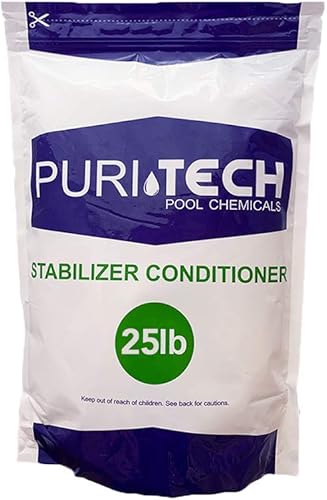 Best for most outdoor pools
Puri Tech Pool Chemicals Stabilizer & Conditioner
9.7/10 our score
See it on Amazon -
2
-
3
 Best for saltwater pools
Clorox® Pool&Spa™ Swimming Pool Chlorine Stabilizer
9.5/10 our score
See it on Amazon
- 4
 Check it
Pool Mate 7-Pounds Premium Pool Stabilizer
Best for precise dosing - 5
 Check it
MAV AquaDoc Pool Stabilizer and Conditioner
Best for mixed pool types - 6
 Best for bulk value in rangeCheck it
- 7
 Check it
Swimables Cyanuric Acid Pool Stabilizer & Conditioner
Best for quick dissolving - 8
 Check it
Clear Works Cyanuric Acid Pool Stabilizer & Pool
Best liquid option
The best cyanuric acid pool stabilizers for outdoor pools
Puri Tech leads for most owners because dose math is clear and the bag size fits a full season. The rest of the list wins on pool size, saltwater use, liquid form or a tighter target range.
Read the trade-off under each pick before you choose.
Puri Tech Pool Chemicals Stabilizer & Conditioner: Best for most outdoor pools
- 100% cyanuric acid
- 25 lb powder
- 1 lb per 10,000 gallons raises CYA 10 ppm
- Resealable packaging with easy-pour design
- For pools and spas
A mid-to-large bag of straight cyanuric acid with simple dosing for outdoor pools and spas in strong sun.
Pros
- Straight 100% cyanuric acid
- Clear dose for 10,000 gallons
- Resealable easy-pour packaging
Cons
- 25 lb is more than small pools need
- Powder must dissolve fully
This Puri Tech 25 lb powder suits outdoor pools and spas in intense sun. It is 100% cyanuric acid, so you are not paying for extra ingredients you did not ask for.
The dose is 1 lb per 10,000 gallons to raise CYA 10 ppm, which makes math easy for a 20,000 gallon pool.
That dose structure is helpful because you can scale it in either direction. A 5,000 gallon spa needs half a pound for the same 10 ppm rise, while a 40,000 gallon pool needs four pounds.
You can weigh it on a kitchen scale or use a clean scoop and check the weight.
The resealable packaging and easy-pour design help with storage between doses. That matters because stabilizer is used in small amounts over months, not all at once.
Powder still needs time to dissolve, so add it with the pump running and let it circulate.
Against the 50 lb Puri Tech, this bag is easier to lift and store. Against smaller bags, it lasts longer for a mid-size pool.
Skip it if your pool is very small and a 4 lb or 5 lb bag would be plenty for the whole season.
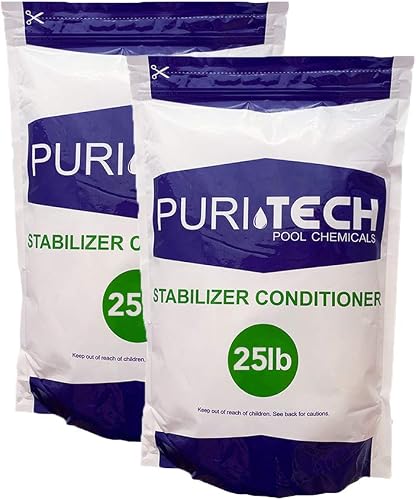
Puri Tech Pool Chemicals 50 lbs Stabilizer: Best for large pools
- 100% cyanuric acid
- 50 lbs powder
- 1 lb per 10,000 gallons raises CYA 10 ppm
- Resealable bag
- For swimming pools and spas
The same straight cyanuric acid formula in a 50 lb bag for large pools that need repeated dosing.
Pros
- Lowest fuss for large pools
- Same clear 10 ppm dose
- Resealable bag for storage
Cons
- 50 lbs is heavy to store and lift
- Too much for a small pool
This Puri Tech 50 lbs stabilizer suits large pools, commercial-style backyard pools and owners who hate reordering. It is also 100% cyanuric acid with the same dose of 1 lb per 10,000 gallons for 10 ppm.
A 50,000 gallon pool can use several pounds at once, so bulk helps.
The maths translates directly to daily use. Raising CYA by 20 ppm in a 30,000 gallon pool takes 6 lb, and a 50 lb bag covers that plus later top-ups.
That avoids the halfway point where a smaller bag runs out mid correction.
The resealable bag keeps the remaining powder drier between uses. That is useful in a garage or pool shed where humidity is common.
Like the 25 lb version, this is powder, so plan for dissolving time and steady circulation after adding.
The trade-off is storage and weight. Fifty pounds is hard to lift onto a shelf and takes floor space.
If you have a small above ground pool, the best above ground pool stabilizer guide will point you to smaller sizes. This pick earns its place for volume, not for small pools.
Clorox® Pool&Spa™ Swimming Pool Chlorine Stabilizer: Best for saltwater pools
- 4 lb granular stabilizer
- Saltwater pool compatible
- Helps chlorine last longer in sun
- For chlorine pools
A small 4 lb granular option sized for saltwater and chlorine pools that need sun protection without a bulk bag.
Pros
- Small bag for smaller pools
- Saltwater pool compatible
- Focused on chlorine protection
Cons
- 4 lb will not last large pools long
- Dose details are on the package
This Clorox Pool&Spa 4 lb granular stabilizer suits saltwater pools and smaller chlorine pools. It is saltwater pool compatible and helps chlorine last longer in sun.
The 4 lb size is a starter amount for a new pool or a first stabilizer dose.
Granular form spreads through the skimmer or a bucket of water. That makes it manageable for a pool owner who does not want a 25 lb bag on day one.
The small bag also makes it easier to add in small steps and retest, which lowers the risk of overshooting your target.
Puri Tech gives clearer dose math in the facts here, so check the package dose before you add. That gap matters if you need to raise CYA by a precise 10 or 20 ppm rather than following a general guidance amount for the pool size.
Against bulk powder, this wins on low commitment. Against the Clear Works liquid, it wins if you prefer a dry product you can scoop.
Choose it for a saltwater pool under about 20,000 gallons, or for a first season test of your CYA needs.
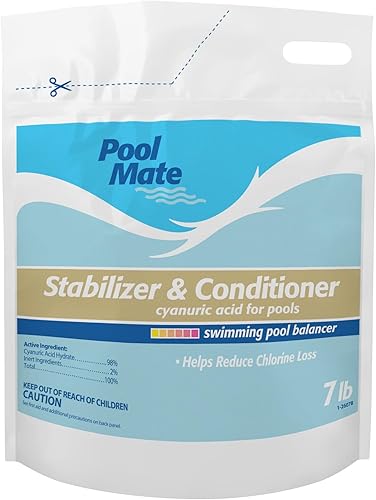
Pool Mate 7-Pounds Premium Pool Stabilizer: Best for precise dosing
- Cyanuric acid for pools
- 7 pounds granular
- 6 oz raises CYA 10 ppm per 5,000 gallons
- Recommended CYA range 40-100 ppm stated
- Helps reduce chlorine loss
A 7 lb granular stabilizer with a per 5,000 gallon dose that helps small and mid-size pools dose more precisely.
Pros
- Dose stated per 5,000 gallons
- Good size for small pools
- States a target CYA range
Cons
- Target range is broad
- Requires premixing or slow skimmer addition
This Pool Mate 7-Pounds stabilizer suits owners who want dose math per 5,000 gallons. It states 6 oz raises CYA 10 ppm per 5,000 gallons.
That smaller step helps a 10,000 gallon pool owner add light doses without guessing.
Pool Mate states a recommended cyanuric acid level of 40 to 100 ppm. That range is broad, so use the low end as your starting target and test again.
The maker also says it helps reduce chlorine consumption by up to 25%, a claim tied to sun protection.
The granular form suits a skimmer application if you add it slowly. The guidance to premix in warm water is worth following for a large first dose, since undissolved granules can sit on the floor or clog a skimmer basket if added too fast.
The trade-off is that a broad target range leaves room for over-stabilizing. Add slowly through the skimmer or premix in warm water, then run the pump for 24 hours to dissolve.
This is a good middle pick for small and mid-size pools.
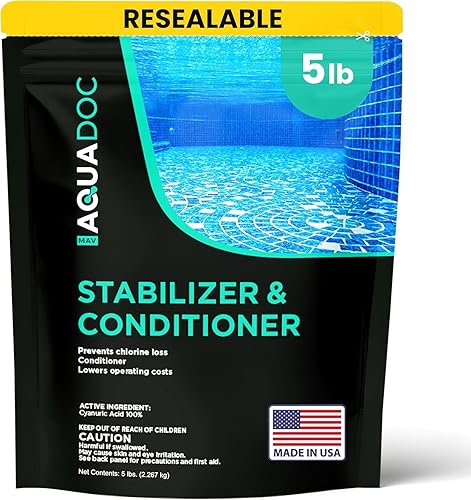
MAV AquaDoc Pool Stabilizer and Conditioner: Best for mixed pool types
- 5 lb powder with cyanuric acid
- For saltwater, chlorine and bromine pools
- States CYA range 30-100 ppm
- For inground and above ground pools
- Made in the USA
A 5 lb powder aimed at owners who want one stabilizer for saltwater, chlorine or bromine pools.
Pros
- Works across common sanitizer types
- Mid-size 5 lb bag
- States a target CYA range
Cons
- No dose amount in the facts here
- Powder form needs dissolving time
This MAV AquaDoc 5 lb powder suits mixed setups. It works in saltwater, chlorine and bromine pools, plus inground and above ground pools.
If you run bromine or may switch sanitizers, that wider fit is useful.
AquaDoc states to keep cyanuric acid between 30 and 100 ppm. That is a wide range, so test and aim for the lower middle rather than the top.
The 5 lb bag is enough for several small corrections without bulk storage.
Powder form means you need to allow dissolving time and keep circulation running. In a bromine pool that may be checked less often, that wait is easy to forget, so set a retest time for the next day rather than checking an hour later.
The trade-off is dose clarity. The facts here do not state how many ounces raise CYA 10 ppm, so you must follow the package directions.
Against Pool Mate, this wins on pool-type range. Against Clorox, it wins on bromine fit.
Choose it when your sanitizer type is mixed or changing.
In The Swim Pool Stabilizer: Best for bulk value in range
- 100% cyanuric acid
- 25 pounds granular
- States optimal CYA 20-50 ppm
- For inground and above ground pools
- Saltwater and chlorine pools
A 25 lb granular stabilizer that states a tighter 20 to 50 ppm target for owners who want less over-stabilizing.
Pros
- Tighter stated target range
- 25 lb for season-long use
- For inground and above ground pools
Cons
- Bulk size for small pools
- No dose amount in the facts here
This In The Swim 25 pounds granular stabilizer suits owners who want a tighter target. It states an optimal CYA range of 20 to 50 ppm, lower than the 30 to 100 or 40 to 100 ranges on other picks.
That lower range can help keep chlorine more active.
It is 100% cyanuric acid for inground and above ground pools, including saltwater and chlorine systems. The maker says it can decrease chlorine use by up to 25% by reducing sun loss.
Treat that as a maker claim, not a promise for every pool.
Granular form helps with even distribution when added through the skimmer. For a large first dose, premixing or adding in two smaller batches can prevent clumping and makes the final CYA easier to predict when you retest.
The trade-off is bulk size and missing dose detail in the facts here. Twenty-five pounds is a lot for a small pool.
If your CYA is already near 80 ppm, read our guide on low stabilizer in pool before adding, and check the high side too. This pick fits large pools where a lower target is the goal.
Swimables Cyanuric Acid Pool Stabilizer & Conditioner: Best for quick dissolving
- 8-pound granular cyanuric acid
- Quick dissolving formula stated
- For saltwater, inground and above ground pools
- Helps protect chlorine from sunlight
An 8 lb granular stabilizer with a quick dissolving formula for routine saltwater and chlorine pool care.
Pros
- Quick dissolving stated
- 8 lb size for mid-size pools
- For salt and chlorine pools
Cons
- No dose amount in the facts here
- Less detail on target CYA
This Swimables 8-pound granular stabilizer suits routine care for saltwater and chlorine pools. It uses a quick dissolving formula and covers inground and above ground pools.
Eight pounds is a practical middle size for a mid-size pool.
The stated job is simple: help protect chlorine from sunlight and reduce chlorine loss. That is the core job of cyanuric acid, and this pick keeps the formula focused.
It is granular, so you can add it through the skimmer or premixed in water.
Quick dissolving is useful when you want to retest sooner. Even so, you should still allow full circulation before testing, since a fast dissolving claim does not mean instant mixing across a large pool with the pump running for only a few minutes.
The trade-off is detail. The facts here do not state a dose amount or a target CYA range, so you need the package directions and a test kit.
Against Pool Mate, this wins on quick dissolving. Against MAV AquaDoc, it wins on saltwater focus.
Choose it for a mid-size pool where 8 lb is the right amount of commitment.
Clear Works Cyanuric Acid Pool Stabilizer & Pool: Best liquid option
- 1 gallon liquid stabilizer
- Liquid cyanuric acid formula
- For chlorine, saltwater, inground and above ground pools
- Add slowly with pump running
A 1 gallon liquid stabilizer for owners who prefer measuring and pouring liquid instead of dissolving powder.
Pros
- Liquid form, no dissolving wait
- 1 gallon for small pools
- For saltwater and chlorine pools
Cons
- Liquid may cost more per dose
- No dose amount in the facts here
This Clear Works 1 gallon liquid stabilizer suits owners who prefer liquid dosing. It is a liquid cyanuric acid formula for chlorine, saltwater, inground and above ground pools.
You measure and pour it with the pump running, with no waiting for powder to dissolve.
Liquid form is handy for small corrections. A gallon is also easier to store than a 25 lb bag in a small pool area.
The maker says it helps keep pool chemicals from breaking down in sunlight and supports clearer water for longer.
Measuring liquid by volume can be precise with a jug or cup. That helps when you need only a small rise in CYA and do not want to weigh powder.
It also avoids dust and the risk of powder clumping in a bucket.
The trade-off is cost per dose and missing dose detail in the facts here. Powder usually gives you more CYA per bag for large pools.
If you want to learn how to add chlorine stabilizer to pool, this liquid pick is the easiest form to practice with. Choose it for small pools or precise top-ups.
How the best cyanuric acid pool stabilizer picks compare
| Product | Size | Form | Dose or target stated |
|---|---|---|---|
| Puri Tech Stabilizer & Conditioner | 25 lb | Powder | 1 lb per 10,000 gal for 10 ppm |
| Puri Tech 50 lbs Stabilizer | 50 lbs | Powder | 1 lb per 10,000 gal for 10 ppm |
| Clorox Pool&Spa Stabilizer | 4 lb | Granular | Saltwater compatible |
| Pool Mate Stabilizer | 7 pounds | Granular | 6 oz per 5,000 gal for 10 ppm |
| MAV AquaDoc Stabilizer | 5 lb | Powder | Target 30-100 ppm |
| In The Swim Stabilizer | 25 pounds | Granular | Target 20-50 ppm |
| Swimables Stabilizer | 8-pound | Granular | Quick dissolving |
| Clear Works Stabilizer | 1 Gallon | Liquid | Liquid dosing |
| Product | Best for | Size | Form | Dose | Our score |
|---|---|---|---|---|---|
| Puri Tech Pool Chemicals Stabilizer & Conditioner | most outdoor pools | 25 lb | Powder | 1 lb per 10,000 gallons for 10 ppm | 9.7 |
| Puri Tech Pool Chemicals 50 lbs Stabilizer | large pools | 50 lbs | Powder | 1 lb per 10,000 gallons for 10 ppm | 9.6 |
| Clorox® Pool&Spa™ Swimming Pool Chlorine Stabilizer | saltwater pools | 4 lb | Granular | 9.5 | |
| Pool Mate 7-Pounds Premium Pool Stabilizer | precise dosing | 7 pounds | Granular | 6 oz per 5,000 gallons for 10 ppm | 9.3 |
| MAV AquaDoc Pool Stabilizer and Conditioner | mixed pool types | 5 lb | Powder | 9.1 | |
| In The Swim Pool Stabilizer | bulk value in range | 25 pounds | Granular | 8.8 | |
| Swimables Cyanuric Acid Pool Stabilizer & Conditioner | quick dissolving | 8-pound | Granular | 8.6 | |
| Clear Works Cyanuric Acid Pool Stabilizer & Pool | liquid option | 1 Gallon | Liquid | 8.3 |
We compared these eight picks by form, size, dose clarity and stated target range. Powder and granular CYA need dissolving time, while liquid CYA mixes faster.
Bigger bags cost less fuss per dose but take more storage space.
We did not test these products by hand. We checked specs, maker statements and buyer patterns, and we matched each pick to a pool size and sanitizer type.
Scores reflect fit for outdoor pool maintenance, not just bag size.
What CYA level should you aim for in a pool?
Aim for the low end of the stated range for your product, then test again. In The Swim states 20 to 50 ppm, MAV AquaDoc states 30 to 100 ppm, and Pool Mate states 40 to 100 ppm.
Those ranges differ, so do not mix targets across brands.
Low CYA means chlorine burns off in sun. High CYA means chlorine is over-protected and less active.
A test kit gives you the real number, so test before every dose. Add half the amount you think you need, let it circulate, then test again.
If your CYA is already high, more stabilizer will make it worse. Our guide on high stabilizer in pool explains dilution and when to wait.
That check saves you from adding CYA to a pool that is already over the target.
Powder, granular or liquid: which form is best?
Powder and granular suit large pools, while liquid suits small pools and top-ups. Puri Tech powder gives clear weight dosing for big pools.
Clear Works liquid pours fast for small corrections.
Swimables granular claims quick dissolving for routine use.
Powder needs time to dissolve and can cloud if dumped in one spot. Add it slowly through the skimmer or a bucket of water.
Liquid needs measuring too, but it mixes without that wait. Our liquid pool stabilizer guide compares the forms in more detail.
Powder stabilizers
Powder is common for bulk bags like the Puri Tech options. It stores well in a resealable bag and doses by weight.
The downside is dissolving time and mess if you pour too fast.
Granular stabilizers
Granular CYA like Clorox, Pool Mate and Swimables spreads well in water. It can be added through the skimmer in small amounts.
Check the dose step for your gallon size before you start.
Liquid stabilizers
Liquid CYA like Clear Works is fast to add and easy to measure in small amounts. It suits above ground and saltwater pools that need light top-ups.
For a full first dose in a large pool, powder may be simpler.
How much stabilizer does your pool need?
Use pool gallons and the dose step on your product, not a generic scoop. Puri Tech states 1 lb per 10,000 gallons for 10 ppm.
Pool Mate states 6 oz per 5,000 gallons for 10 ppm.
Both math paths land in the same place.
Example: a 15,000 gallon pool that needs CYA up 20 ppm needs 3 lb by the Puri Tech math. That is 1.5 lb for each 10 ppm step, times two steps.
Always split a large dose into two smaller adds and retest between them.
Example math for common pool sizes
A 10,000 gallon pool needs 1 lb for a 10 ppm rise using the Puri Tech dose. A 20,000 gallon pool needs 2 lb for that same rise.
Pool Mate math gives the same result in its own units, with 12 oz for a 10,000 gallon pool per 10 ppm step.
If you are starting from zero after a refill, you may need two or three steps to reach your target. That is why a 25 lb bag is practical for a family pool, while a 4 lb bag suits a small above ground pool that needs only one or two corrections.
If your product does not state a dose in the facts here, follow the package and test. For saltwater pools, our best pool stabilizer for salt water pool guide helps you match size to your system.
Never add stabilizer and shock at the same time without checking directions.
Is cyanuric acid safe for saltwater and bromine pools?
Yes, when the product states that use and you keep CYA in range. Clorox states saltwater pool compatibility.
MAV AquaDoc states use in saltwater, chlorine and bromine pools.
Swimables and Clear Works also state saltwater use.
Salt cells make chlorine all day, and sun still burns that chlorine off. Stabilizer helps that chlorine last longer.
Bromine pools also lose sanitizer in sun, which is why MAV AquaDoc lists bromine fit.
Saltwater pools
Choose Clorox, Swimables or Clear Works for a saltwater pool. Start with a small bag or gallon, test CYA, and add in steps.
Saltwater does not remove the need for stabilizer.
Bromine pools
MAV AquaDoc is the clearest bromine pick here. Check your bromine system directions before adding CYA.
Test sanitizer and CYA together after each dose.
What happens if your stabilizer level is too low?
Low CYA lets sun burn off chlorine, so you add more chlorine and still lose it. That wastes chemical and leaves water less sanitized on sunny days.
Test for CYA and free chlorine together to see the pattern.
Add CYA in small steps and let the pump run. Powder and granular need hours to dissolve, so retest after circulation, not right after pouring.
Our guide on low stabilizer in pool walks through that fix step by step.
Low CYA after a refill is common. New water starts near zero CYA.
A first dose for a new pool is larger than a top-up dose, so measure your gallons first. Use the dose step for your product and split the add.
Verdict: which cyanuric acid pool stabilizer should you buy?
Buy the Puri Tech 25 lb for most outdoor pools, the 50 lb version for large pools, and the Clorox 4 lb for a first saltwater dose. Choose Clear Works liquid if you prefer pouring over dissolving powder.
Choose Pool Mate if dose math per 5,000 gallons helps you.
Match bag size to pool size before you compare brands. A small pool does not need 50 lb of powder.
A large pool will burn through 4 lb fast. Test CYA before you add, dose in steps, and keep the target range for your product.
Start with the top pick, test your water, and add stabilizer in small amounts. Your next step is a test kit and a gallon count, not a bigger bag.
Our top 3 picks at a glance
-
1
Best for most outdoor pools
Puri Tech Pool Chemicals Stabilizer & Conditioner
9.7/10 our score
See it on Amazon -
2
-
3
Best for saltwater pools
Clorox® Pool&Spa™ Swimming Pool Chlorine Stabilizer
9.5/10 our score
See it on Amazon
Frequently asked questions
How much cyanuric acid should be in a pool?
Test and aim inside the range stated for the stabilizer you use. Pool Mate states 40 to 100 ppm, MAV AquaDoc states 30 to 100 ppm, and In The Swim states 20 to 50 ppm.
Use your test result, not a guess, and add in small steps.
Does cyanuric acid lower if you shock the pool?
No. Shock is for sanitizing and clearing water, while stabilizer protects chlorine from sun.
Our guide to what is pool stabilizer vs shock explains the different jobs.
You still need to test CYA after major water changes.
Can cyanuric acid go too high?
Yes. Too much stabilizer can make chlorine less effective, so test before adding more.
Our guide to high stabilizer in pool explains why dilution is the usual fix.
Add stabilizer in small amounts and retest.
Is liquid stabilizer better than powder?
Liquid is faster to add because it does not need to dissolve, while powder is often easier to dose by weight for large pools. Our comparison of liquid pool stabilizer walks through that choice.
Pick the form you will measure correctly every time.


