Pool Chemicals and Sanitizers Guide
Swimming pool chemicals fall into four jobs: sanitize, shock, balance and prevent. Chlorine or bromine does the daily sanitizing, shock handles heavy use, balancers set pH and alkalinity, and algaecide helps prevent algae. The routine below shows what to add, when and how much.
On this page (18 sections)
- What are the main categories of swimming pool chemicals?
- How does chlorine work in a pool?
- How do you dispense chlorine tablets?
- How does bromine compare to chlorine?
- How does a salt system replace chlorine?
- When should you shock a pool?
- How do you balance pH and alkalinity?
- How do stabilizer and other balancers work?
- How do you prevent and treat algae?
- How do you clear cloudy water?
- How do you remove stains and scale?
- How do you open a pool for the season?
- How do all-in-one products compare?
- How do you store pool chemicals safely?
- How do brand choices compare?
- How do safety rules work for chemicals and hot tubs?
- What is a weekly pool chemical routine?
- How should you choose swimming pool chemicals for your pool?
Swimming pool chemicals work as a system, not as single products. You need a sanitizer to kill germs, balancers to keep water comfortable and safe for equipment, and shock and algaecide for problems.
Chemicals alone do not keep a pool clear. Circulation, filtration and brushing do as much work as chemistry.
Run the pump, skim debris and brush walls so sanitizer can reach every surface.
What are the main categories of swimming pool chemicals?
Pool chemicals fall into sanitizers, shock, balancers, stabilizers and specialty treatments. Each category does a different job.
Sanitizers kill bacteria and keep water safe. Most pools use chlorine, some spas use bromine, and a salt system still relies on chlorine it makes from salt.
Shock is a fast dose after heavy use, a storm or a green pool. It burns off combined chlorine and organic matter a normal dose cannot handle.
Balancers adjust pH, total alkalinity and calcium hardness. pH affects comfort and chlorine strength, alkalinity stops pH swinging, and hardness protects plaster and equipment.
Stabilizer, or cyanuric acid, protects chlorine from sunlight. Too much slows chlorine, so test and keep it in your kit range.
Specialty products cover specific problems. Algaecide prevents algae, clarifier helps fine particles clump for the filter, and stain remover treats metal stains.
How does chlorine work in a pool?
Chlorine sanitizes by killing bacteria, oxidizing oils and stopping algae growth. It works best when pH is in the range your test kit recommends, because high pH makes chlorine less active.
Chlorine comes in several forms. Tablets dissolve slowly in a floater or feeder and give steady levels.
Granular and liquid chlorine raise the level quickly and suit shock or a rise after a party. Each form has the same active ingredient, but dose and speed differ.
Tablets suit daily use because they last longer and need less attention. For a closer look at daily tablets, see our guide to the best pool chlorine tablets.
Liquid chlorine suits quick corrections. Granular forms suit shock and start-up.
Chlorine loses strength in sunlight without stabilizer. Outdoor pools should test for stabilizer and keep it balanced.
Indoor pools need less stabilizer, because there is no direct sun to burn chlorine off.
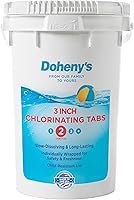
The tablets in this size dissolve slowly, which helps keep chlorine steady between tests. A large bucket suits owners who use tablets all season and want fewer trips to buy refills.
If you use a feeder, 3 inch tablets are the standard size for most automatic feeders.
Stabilized tablets already carry UV protection, so they resist depletion from sunlight. That helps outdoor pools, but you still need to test stabilizer in the water.
Tablets add stabilizer every time they dissolve, and levels can creep up over a season.
Owners with small pools or short seasons may not need a 50 lb bucket. A smaller pack can last more than a season for a small pool, and old chlorine is less effective.
Buy the size you will use within the season.
How do you dispense chlorine tablets?
Tablets need a floater, feeder or skimmer dispenser to dissolve at a safe rate. Never drop a tablet straight into the pool, because it can bleach plaster and create a high chlorine spot.
A floating dispenser is the simplest option. Set it in the pool, let it drift with the current and adjust the vents to control flow.
It needs refills when tablets run low, so check it each time you test the water.
An automatic feeder on the return line dissolves tablets with pump circulation. It gives steady levels with less daily attention, but it needs plumbing and regular tablet checks.
Many in-ground pools use a feeder for this reason.
A skimmer dispenser sits in the skimmer basket and uses pump flow. It is easy to reach for refills, but it only works while the pump runs.
It can also be hard to control the exact dose.
This dispenser floats on its own, so you do not need plumbing or a feeder. The adjustable vents let you change flow for pool size, temperature and use.
Low vents give gentle sanitation, and open vents dissolve faster after heavy use.
It holds multiple tablets, which cuts down on refill trips. The low profile design helps it float out of the way while swimmers are in the pool.
It works with most chlorine and bromine tablets, so you can match it to the sanitizer you already buy.
Check vents and tablet level each week. A dispenser that sits empty for days lets chlorine fall to zero, and algae can start fast in warm water.
A quick weekly refill is part of the routine, not an extra chore.
For more options, compare the best pool chlorine tablet dispenser picks and match the dispenser to your tablet size.
How does bromine compare to chlorine?
Bromine sanitizes like chlorine but with less odor and less sensitivity to pH. Many hot tub owners choose it for that reason, while most large pools use cheaper, widely available chlorine.
Bromine stays active across a wider pH range than chlorine. Chlorine loses power as pH rises, so bromine is more forgiving in a spa where pH moves quickly.
Bromine also breaks down more slowly in sunlight and needs less stabilizer. That helps outdoor spas and is another reason bromine is common in hot tubs.
The trade-off is cost and availability. Bromine tablets cost more per season and still need a dispenser.
For a chlorine-free option, read our guide to a chlorine free pool and compare the trade-offs.
Before you switch, check your dispenser and feeder. Some feeders are for chlorine only and some tablets do not fit, so match tablet size and type to what you own.
How does a salt system replace chlorine?
A salt chlorine generator makes chlorine from dissolved salt, so you add salt instead of tablets. The water still contains chlorine, so test pH, alkalinity and stabilizer as usual.
Use pool salt only, in the amount your generator manual recommends for your pool volume. Household salt can carry additives you do not want in pool water.
Clean and inspect the salt cell on schedule, because scale reduces chlorine output. When levels drop despite the system running, check the cell first.
Salt systems do not remove the need for shock after a storm, a party or a green pool. Liquid chlorine or granular shock can raise the level while the generator catches up.
Compare the best pool salt chlorine generator options by pool size and cell life. Then buy pool salt such as the options in our guide to best pool salt for salt water pool.
When should you shock a pool?
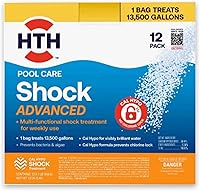
Shock a pool after heavy use, a storm, or when combined chlorine smells strong. Shock is a fast dose that slow tablets cannot provide, and it clears the organic load that makes water dull or irritating.
A strong chlorine smell often means combined chlorine, not too much free chlorine. Cloudy water after a party or a test showing little free chlorine are other signs you need shock.
Shock also helps when algae first appears. Brush surfaces, filter and shock together, so dead algae is removed rather than left to feed more growth.
Read the label for dose by pool volume. Add shock with the pump running, pour it around the edge and keep swimmers out until free chlorine returns to your kit range.
Never mix shock with other chemicals in the bucket.
For granular shock, see the best calcium hypochlorite pool shock options. For liquid shock, compare the best liquid chlorine for pool picks, which are easier to dose in small pools.
How do you balance pH and alkalinity?
pH and alkalinity control comfort, chlorine strength and equipment life. Test them weekly and adjust in small steps, because large swings cause more harm than a small correction.
pH that is too high makes chlorine weak and can cause cloudiness and scale. pH that is too low stings eyes and can etch plaster and metal, so aim for the middle of your kit range.
To lower pH, most owners use a reducer such as muriatic acid or sodium bisulfate. Add it with the pump running and retest after circulation, as explained in how to lower ph in pool water.
Alkalinity buffers pH and stops it bouncing. If pH keeps rising, alkalinity is often too low, so adjust alkalinity first and then check pH again.
Calcium hardness protects the pool surface. Low hardness can etch plaster, while high hardness can cause scale and cloudiness, so use a hardness product only when testing shows a need, as explained in our guide to pool chemicals hardness.
How do stabilizer and other balancers work?
Cyanuric acid stabilizer protects chlorine from sunlight, but too much slows sanitation. Outdoor pools need it to keep chlorine active.
Indoor pools need little or none.
Test for it monthly in summer.
Stabilizer is often called conditioner on labels. Adding stabilized tablets and shock with stabilizer raises the level over time.
If the level gets too high, the only fix is to drain some water and refill. That is why you test instead of guessing.
Other balancers include alkalinity increaser, pH increaser and calcium increaser. Each one changes one reading.
Adding a product that changes two readings at once makes it harder to control the result.
Brand names can be confusing, so read the active ingredient and the job on the label. A product for alkalinity and a product for pH may look similar in the aisle.
The job description and dose table matter more than the brand.
For stabilizer products, compare the best cyanuric acid pool stabilizer options and dose by test result. Add a little, wait for circulation and retest before you add more.
How do you prevent and treat algae?
Algaecide prevents algae, but it does not replace sanitizer or filtration. Think of it as a safety net for warm water, heavy use and sunny weeks.
The main defense is still steady chlorine, clean filtration and brushing.
Algae grows fast when chlorine drops, water warms and sunlight hits the surface. Green algae floats and coats walls.
Yellow or mustard algae often grows in shaded spots. Black algae forms stubborn spots on plaster.
Each type responds best to brushing, shock and filtration.
A non-metallic algaecide suits most pools because it will not stain plaster. It also suits pools with attached spas, waterfalls or fountains, where foaming or odor would be a problem.
It works with chlorine, bromine, biguanide and salt systems.
This 1 quart bottle covers standard maintenance for a typical backyard pool. The maker recommends a higher initial dose, a lower weekly maintenance dose and a higher dose for visible algae.
Dose by pool volume, not by guess.
The formula is pH tolerant, so you do not need to rebalance water before you use it. That helps when algae appears during a busy week and pH has drifted.
Add it with the pump running and keep filtration on for full circulation.
Algaecide works best as prevention. If the pool is already green, brush, shock and filter first, then add algaecide to stop regrowth.
For product choices by algae type, see pool chemicals for algae.
How do you clear cloudy water?
Cloudy water usually means filtration, sanitizer or balance is off, not that you need more of every chemical. Test first, then treat the cause.
Adding clarifier to a pool with a dirty filter will not fix it.
Common causes include low chlorine, a clogged or undersized filter, high pH, dead algae and fine particles from a storm. Each cause has a different fix.
Shock helps for low chlorine. Backwashing or rinsing helps for a dirty filter.
Balancing helps for high pH.
Clarifier helps fine particles clump so the filter can catch them. It works best after you shock and brush, and while the pump runs.
It does not kill algae or bacteria, so it never replaces sanitizer.
If cloudiness follows a green pool, give the filter time. Dead algae particles are small, and a filter needs hours to polish the water.
Run the pump, brush and vacuum to waste if your setup allows it, and retest each day.
For a full diagnosis, follow our guide to cloudy pool water. It walks through tests in the order that saves you money.
How do you remove stains and scale?
Stain remover treats metal stains, while scale control prevents calcium deposits. The two problems look different and need different products.
Test the water and look at the stain before you buy.
Metal stains often appear as green, blue, brown or black marks on plaster or tile. They come from copper, iron or manganese in the water or from a corrosion issue.
A stain remover lifts the metal so the filter can remove it.
Scale is a white, crusty deposit at the waterline or on equipment. It grows when hardness and pH are high and water is warm.
Brushing and balancing help, and a scale product can slow new buildup.
Do not use a stain remover and a scale product at the same time unless both labels allow it. Some products change pH or chlorine demand.
Treat one problem, retest and then treat the next.
For metal stains, compare the best pool stain remover options. Then test pH, alkalinity and hardness so the stain does not return.
How do you open a pool for the season?
A start-up kit gives you pre-measured doses for opening day, plus the extras a new season needs. It saves guesswork when water has sat all winter.
You still need to test, brush and run the filter.
A typical opening kit includes shock, algaecide, clarifier and a stain or scum treatment. Shock gets the water safe to swim in.
Algaecide defends against the algae that starts in spring. Clarifier helps the filter polish fine particles.
Pre-measured doses help because opening water volume is hard to estimate. Still, check your pool volume before you add a full kit.
A kit sized for 35,000 gallons is too much for a small pool.
This kit suits in-ground pools at opening, when water needs a full reset. Four bags of sodium dichlor shock get the water clean and clear.
The clarifier helps particles clump for the filter, and the algaecide works with shock to defend against algae.
The sun sorb treatment soaks up suntan oils, body oils and scum at the surface. That helps keep the waterline cleaner in the first weeks of the season.
It does not replace brushing or skimming.
Open the pool in steps. Remove the cover, start the pump, brush, test and then add the kit in the order the labels direct.
For more opening options, see the best pool start up chemicals guide.
Closing a pool uses a different set of products. If you close for winter, compare the best pool closing kit options and follow the closing steps for your climate.
How do all-in-one products compare?
All-in-one products save space but rarely match separate products for each job. A single granule cannot dose as precisely as separate sanitizer, balancer and algaecide.
They can suit small pools, but large pools often do better with separate products.
All-in-one formulas try to sanitize, clarify and prevent algae in one dose. That is convenient for owners who want fewer bottles.
The trade-off is control, because you cannot raise chlorine without also adding clarifier or algaecide.
Separate products cost more upfront but last longer and adjust to test results. If chlorine is low but pH is fine, you can raise chlorine alone.
With an all-in-one product, you may overdose the other ingredients.
For a small above-ground pool or a low-maintenance setup, an all-in-one product can be a reasonable choice. Compare the best all in one pool chemicals options by pool size and sanitizer type before you switch.
How do you store pool chemicals safely?
Store pool chemicals dry, cool and away from children, in their original containers. Heat, moisture and sunlight break down chlorine and make labels hard to read.
Most products state storage conditions on the label, so follow them.
Keep granular shock and tablets dry. A damp bucket can clump tablets and weaken shock.
A tight lid and a dry shelf in a garage or shed work best for most owners.
Never mix chemicals in one container. Chlorine products can react with acids and with each other.
Keep shock, acid and algaecide in separate spots and use clean, labeled scoops for each.
Liquid chlorine is heavy and can leak. Store it upright, check caps regularly and keep it out of direct sun.
If a container leaks, move it to a secondary tray and follow label safety steps.
For a full storage checklist, read pool chemical storage. Safe storage protects swimmers, pets and the strength of the product.
How do brand choices compare?
Brand choice matters less than dose, form and fit for your pool type. Match product to pool size, sanitizer type and problem first, since an in-ground dose can overwhelm a small pool.
In-ground pools usually need larger packs, feeders and stronger shock doses. Above-ground pools need smaller doses, and hot tubs need the smallest doses of all.
For in-ground pools, start with our guide to the best pool chemicals for inground pool. It breaks down products by job for larger volumes.
For smaller pools, see best pool chemicals for above ground pool. Dosing errors are more common there, because a little goes a long way.
If you buy a trusted brand, compare the best clorox pool chemicals and the best hth pool chemicals by job. For bulk buyers, the best pool chemicals bulk guide compares large packs by cost per dose, so buy bulk only for products you will finish in the season.
How do safety rules work for chemicals and hot tubs?
Pool chemicals are safe when you follow label doses, keep swimmers out during shock and store them away from children. The main risks are mixing products, adding too much at once and swimming too soon.
Add chemicals with the pump running so they mix through the pool. Pour liquids around the edge, not in one spot, and keep a clean scoop for each product.
Never mix chlorine with acid or with ammonia based products. Never add shock and algaecide to the same bucket at the same time.
Add one, let it circulate, then add the other.
Hot tubs need extra care because the water is hotter and bathers sit longer. A dose safe in a large pool can be too strong in a small spa, so check can you use pool chemicals in a hot tub before you switch products.
Keep a test kit by the pool and test before swimmers get in after any dose. If eyes sting or skin feels irritated, test free chlorine and pH before anyone swims again.
What is a weekly pool chemical routine?
A weekly routine of test, brush, balance and refill keeps most pools clear with little guesswork. Once the pool is balanced, your main weekly jobs are testing, adjusting chlorine and checking the dispenser.
Shock and algaecide are as-needed, not weekly.
Test free chlorine, pH and alkalinity every few days in summer. Test stabilizer and hardness monthly.
Write the results down, because trends tell you more than one reading. A slow rise in stabilizer or a steady pH climb points to a fix.
Brush walls, steps and the waterline each week. Algae starts where water sits still.
Brushing also helps chlorine reach the surface and keeps the waterline cleaner.
Check the floater or feeder and refill tablets before they run out. Adjust vents when weather or use changes.
Add shock only when tests or conditions call for it, not on a fixed day.
Run the pump long enough for full circulation each day. Clean or backwash the filter when pressure rises or water stays dull.
Chemistry works best when the filter and pump do their share.
How should you choose swimming pool chemicals for your pool?
Choose chemicals by pool type, size and the job you need done. In-ground pools, above-ground pools and hot tubs need different doses and often different products.
For daily sanitizing, choose tablets for steady levels or liquid for quick corrections. For shock, choose granular or liquid by pool size, and for balance buy separate pH, alkalinity and hardness products so you can adjust one reading at a time.
Size the pack to your season. Large buckets suit high-use in-ground pools, while small packs suit small pools and short seasons.
Old chlorine loses strength, so a huge pack lasting two seasons may not be the best buy.
Keep safety in the plan. Store chemicals dry and locked away, test before swimmers enter and follow label doses by volume.
A simple routine with steady chlorine and weekly tests will keep water clear more reliably than buying every specialty product.
For a final check, match your next buy to the guides above. In-ground owners should see the best pool chemicals for inground pool picks, above-ground owners should see the best pool chemicals for above ground pool picks, and brand loyal buyers can compare the best clorox pool chemicals options.
Frequently asked questions
What swimming pool chemicals do you need to start?
You need a sanitizer such as chlorine tablets or liquid chlorine, a shock, a pH and alkalinity balancer, a stabilizer for outdoor pools and a test kit. Add algaecide for prevention and clarifier for cloudy water.
Start with a start-up kit if you are opening a pool for the season.
How often should you add chlorine to a pool?
Chlorine is needed continuously in a chlorinated pool, not in one weekly dose. Tablets in a floater or feeder dissolve slowly and keep a steady level.
Test every few days and adjust the floater vents or feeder setting to hold the level your test kit recommends.
Can you use pool chemicals in a hot tub?
Some pool chemicals work in hot tubs, but many do not. Hot tubs need smaller doses, different sanitizer levels and products made for high heat and high bather load.
Check the label for hot tub use before you add pool shock, tablets or balancers to spa water.
What is the difference between chlorine and bromine for pools?
Chlorine is the standard pool sanitizer and costs less per season. Bromine is often chosen for hot tubs because it has less odor and works across a wider pH range.
Both kill bacteria and algae, and both need a dispenser or feeder to dissolve at the right rate.