8 Best Liquid Chlorine for Pools (November 2026)
The best best liquid chlorine for pool include the CPDI Champion Pool Shock for most backyard pools, the CPDI Champion 4 Pack Pool Shock Liquid for bulk value, and the EZ POOLS BioGuard Chlorinating Liquid for pool and spa shock.
On this page (10 sections)
- The best liquid chlorine for pool options, ranked
- How to use the best liquid chlorine for pool without common mistakes
- Should you choose 12.5 percent, 10 percent or a lower strength?
- How much liquid chlorine should you add each time?
- When should you add liquid chlorine to your pool?
- Is liquid chlorine better than tablets or granules?
- How do you store gallons of liquid chlorine safely?
- What should you do if chlorine gets too high?
- Can you use household bleach instead of pool liquid chlorine?
- Verdict: best liquid chlorine for pool, by pool type
The best liquid chlorine for pool use is the CPDI Champion Pool Shock in a 1 gallon jug, because it gives you ready to use 12.5% strength with clear dosing directions. Pick a 4 pack if you treat a large pool often, and pick a single gallon if you want the smallest storage load.
Liquid chlorine is unstabilized sodium hypochlorite, so it sanitizes fast and does not add calcium or stabilizer to your water. That makes it useful for routine sanitation, shock treatments and opening a pool in spring.
Our score weighs specs, features and buyer feedback against what you are shopping for.
We compared 12.5% options, 1 gallon jugs and bulk packs so you can match strength and package size to your pool. For a wider look at sanitizers, start with our swimming pool chemicals guide.
For feed type trade offs, see liquid chlorine vs tablets for pools.
Our picks at a glance
-
1

-
2

-
3
- 4
 Check it
CPDI Champion Pool Shock Liquid Chlorine 12.5
Best 2 pack for 12.5 percent strength - 5
 Check it
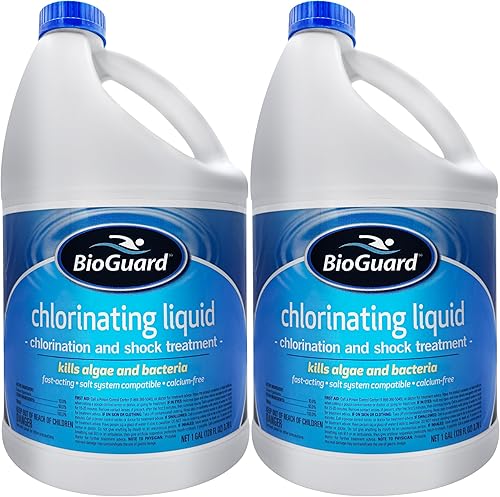
EZ POOLS BioGuard Chlorinating Liquid
Best single gallon BioGuard option - 6
 Check it
PoolFix Liquid Pool Shock 12.5%
Best commercial grade bulk alternative - 7
 Check it
Discount Pool Mart DPM HASA Liquid Chlorine
Best for detailed dosing guidance - 8
 Check it
Home and Country USA Liquid Chlorine 1 Gallon
Best budget 2 pack
The best liquid chlorine for pool options, ranked
The top picks share one trait: a clear strength and a package size you can store safely. Champion products lead because the 12.5% strength and dosing are explicit, while BioGuard and budget packs suit different storage and budget needs.
CPDI Champion Pool Shock: Best for most backyard pools
- 12.5% concentrated strength
- 1 gallon, 128 fluid ounces
- Ready to use liquid chlorine
- For new pools and spring start up
A single gallon of commercial grade 12.5% liquid chlorine with clear superchlorination directions. It is the simplest choice for routine sanitation and shock treatments.
Pros
- Clear 12.5% strength
- Single gallon is easy to store
- Detailed dosing for 10,000 gallons
Cons
- Single gallon costs more per ounce than bulk packs
- Strong chemical that needs careful storage
This is the best fit for most backyard pools because a single 1 gallon jug of 12.5% liquid chlorine is easy to store and dose. You get 128 fluid ounces with no mixing required, and CPDI gives a direct superchlorination range per 10,000 gallons.
CPDI says use 52 to 104 oz. of the 12.5% product per 10,000 gallons to yield 5 to 10 ppm available chlorine for a new pool or spring start up. That range helps you start low, test, and add more only if needed.
It also calls for pH between 7.2 to 7.6 and alkalinity between 50 to 100 ppm, which frames daily use beyond shock doses. In practice that means a test kit is part of the routine, not an optional extra.
The trade off is cost per gallon. A single jug costs more per ounce than a 2 pack or 4 pack, and liquid chlorine loses strength over time.
Buy one gallon if you are new to liquid chlorine or have limited storage.
CPDI Champion 4 Pack Pool Shock Liquid: Best for bulk value
- 12.5% sodium hypochlorite
- Four 1 gallon jugs
- 512 fluid ounces total
- NSF/ANSI 60 certified
- Pour or pump use
Four gallons of the same Champion 12.5% formula for pools that use liquid chlorine often. It lowers the cost per gallon for large or heavily used pools.
Pros
- Lowest cost per gallon in this group
- Four jugs last through a season
- Can be poured or pump fed
Cons
- Needs cool, dark storage for four gallons
- Heavy case to carry and store
This 4 pack is the best fit for large pools, commercial use or owners who add liquid chlorine every week. You get four 1 gallon jugs of 12.5% sodium hypochlorite, for 512 fluid ounces total.
CPDI says the formula is NSF/ANSI 60 certified and can be poured directly or fed through a peristaltic metering pump. That pump option matters for pool operators who want steady dosing without lifting a jug all day.
It also states the liquid will not cloud water or leave residue that can stain surfaces, unlike granular chlorine. For inground and above ground pools that means clearer water after treatment and less clean up on walls and floors.
The trade off is storage. Four gallons are heavy, and you need a cool, dark place to keep them.
Buy this pack if your pool uses a gallon or more in a few weeks, and skip it if one gallon would last all season.
EZ POOLS BioGuard Chlorinating Liquid: Best for pool and spa shock
- 2 pack, 2 gallons plus e-book
- 256 fluid ounces total
- Swimming pool and spa liquid shock
- Raises chlorine and controls algae
A two gallon BioGuard liquid shock pack for pools and spas, with a pool and spa tips e-book included. It suits owners who want a ready to pour shock treatment.
Pros
- Two gallons for pool or spa use
- Includes a tips e-book
- Controls algae and raises chlorine
Cons
- Strength is not stated in the name
- Two gallons still need safe storage
This BioGuard 2 pack is the best fit for pool and spa owners who want a ready to pour liquid shock treatment. You get two gallons, for 256 fluid ounces, plus a pool and spa tips e-book.
EZ POOLS describes it as liquid chlorine shock that raises chlorine and controls algae. That makes it a practical choice for shock treatment after a party, a storm or a cloudy water event.
The two gallon format suits owners who use liquid chlorine for both a main pool and a smaller spa, since each jug can be poured in small amounts without mixing first. It also avoids the residue issue that can come with granular products on spa surfaces.
The trade off is that the strength is not stated in the name, unlike the 12.5% Champion and PoolFix options. Buy it if you prefer the BioGuard brand and a two gallon supply, and compare strength on the jug before dosing.
CPDI Champion Pool Shock Liquid Chlorine 12.5: Best 2 pack for 12.5 percent strength
- 12.5% sodium hypochlorite
- 1 gallon 2 pack
- 256 fluid ounces total
- NSF/ANSI 60 certified
- No mixing required
Two gallons of Champion 12.5% liquid chlorine in convenient 1 gallon jugs. It is a middle ground between a single jug and a full bulk case.
Pros
- Confirmed 12.5% strength
- Two jugs balance value and storage
- Pour directly or use a pump
Cons
- More storage than a single gallon
- Still a strong oxidizer to handle
This Champion 2 pack is the best fit for owners who want confirmed 12.5% strength without buying four gallons. You get two 1 gallon jugs, for 256 fluid ounces, of 12.5% sodium hypochlorite.
CPDI says the liquid is NSF/ANSI 60 certified, ready to use, and able to be poured directly or fed through a peristaltic metering pump. It also says the formula does not cloud water or leave residue that can stain surfaces.
That combination of pour or pump use makes it adaptable for home pools and for small commercial settings where steady feed helps. Two separate jugs also make daily handling easier than one larger container.
The trade off is storage for two gallons, which is more than a single jug but less than a case. Buy this pack if you want a season supply for a mid size pool, and skip it if you need the lowest cost per gallon.
EZ POOLS BioGuard Chlorinating Liquid: Best single gallon BioGuard option
- 1 gallon, 128 fluid ounces
- Swimming pool and spa liquid shock
- Raises chlorine
- Controls algae
A single gallon of BioGuard chlorinating liquid for pools and spas. It is a simple pick when you want one jug without committing to a multi pack.
Pros
- Single gallon is easy to start with
- Suits pool and spa shock use
- Controls algae and maintains sanitized water
Cons
- Strength is not stated in the name
- Higher cost per gallon than multi packs
This single gallon BioGuard option is the best fit for owners who want one jug for pool or spa shock treatment. You get 128 fluid ounces of liquid chlorine shock in a size that is easy to carry and store.
EZ POOLS describes it as a treatment that raises chlorine, controls algae and maintains clean sanitized water. That makes it a simple choice for a first liquid chlorine purchase or a small pool.
A single gallon is also easier to use before strength fades, which matters because unstabilized chlorine can weaken in heat and sunlight. It gives new users a manageable amount to learn dosing and testing without waste.
The trade off is value. A single gallon costs more per ounce than the BioGuard 2 pack, and the strength is not stated in the name.
Buy it if storage is tight or you want to try liquid chlorine before committing to more.
PoolFix Liquid Pool Shock 12.5%: Best commercial grade bulk alternative
- 12.5% sodium hypochlorite
- 4 pack, 512 fluid ounces
- Unstabilized chlorine
- Fast acting and non staining
A 4 pack of commercial grade 12.5% liquid shock with unstabilized chlorine and no added cyanuric acid. It suits owners who want bulk supply without stabilizer in the formula.
Pros
- Bulk 4 pack at 12.5%
- Unstabilized chlorine with no added cyanuric acid
- Fast acting and non staining
Cons
- Four gallons need storage space
- Unstabilized chlorine burns off faster in sun
This PoolFix 4 pack is the best fit for owners who want bulk commercial grade supply at 12.5% strength. You get four gallons, for 512 fluid ounces, of sodium hypochlorite liquid pool shock.
PoolFix says the formula is fast acting, ready to use, non staining and unstabilized, with no added cyanuric acid. That means it will not add stabilizer to your water, which can help if your cyanuric acid is already high.
It also describes the product as compatible with all pool types for residential and commercial use, and made in the USA from formulas used for commercial pool servicing. Fast dispersal means chlorine is available quickly after pouring.
The trade off is that unstabilized chlorine burns off faster in sunlight, so outdoor pools may need more frequent dosing. Buy this pack for bulk value and clear strength, and plan for testing more often in hot sun.
Discount Pool Mart DPM HASA Liquid Chlorine: Best for detailed dosing guidance
- Sodium hypochlorite 12.5 percent
- 1 gallon, 128 fluid ounces
- Made in USA
- Commercial grade pool chlorine liquid
A 1 gallon HASA 12.5% liquid chlorine with detailed directions for routine dosing and weekly superchlorination. It is a strong fit for owners who want exact amounts per 10,000 gallons.
Pros
- Clear routine and shock dosing
- 12.5% strength in a 1 gallon jug
- Made in USA commercial grade formula
Cons
- Single gallon at a higher per gallon cost
- Requires careful pH and alkalinity control
This HASA liquid chlorine is the best fit for owners who want detailed dosing directions on the package. You get a 1 gallon jug, for 128 fluid ounces, of 12.5% sodium hypochlorite made in the USA.
Discount Pool Mart gives routine and superchlorination amounts per 10,000 gallons. It says to superchlorinate every 7 days, or as necessary, with 50 to 100 fl. oz. per 10,000 gallons to yield 5 to 10 ppm available chlorine.
It also gives a routine dose of 11 fl. oz. per 10,000 gallons to yield a residual between 0.6 and 1.0 ppm, which is useful for daily maintenance planning. That detail helps you separate shock dosing from everyday sanitation.
It gives pH and alkalinity targets, and warns that re entry is prohibited above 4 ppm. The trade off is a single gallon at a higher per gallon cost, so buy it if clear directions matter more than bulk value.
Home and Country USA Liquid Chlorine 1 Gallon: Best budget 2 pack
- Liquid chlorine 1 gallon 2 pack
- 256 fluid ounces total
- Maintains clean sanitized water
- Two 1 gallon containers
A 2 pack of 1 gallon liquid chlorine for maintaining clean sanitized water. It is a budget friendly way to keep a backup gallon on hand.
Pros
- Two gallons in one order
- 1 gallon size is easy to pour
- Maintains clean sanitized water
Cons
- Strength is not stated in the name
- Fewer dosing details than commercial grade options
This Home and Country USA 2 pack is the best fit for budget shoppers who want two gallons for routine pool sanitation. You get two 1 gallon containers, for 256 fluid ounces, of liquid chlorine.
The product is described as maintaining clean sanitized water, which fits daily or every few days dosing for a steady chlorine residual. Two jugs also give you a backup gallon when one runs low.
Separate 1 gallon containers make pouring and measuring simpler than a large bulk jug, and they fit more easily into a storage shed or garage cabinet. That format suits smaller pools where a 4 pack would take too long to use.
The trade off is limited detail. The strength is not stated in the name, and dosing guidance is less specific than the 12.5% commercial grade options.
Buy it for value and convenience, and confirm strength and dosing on the jug before use.
How to use the best liquid chlorine for pool without common mistakes
Liquid chlorine works best when you test first, dose to a target and test again. That habit prevents both under sanitizing and adding far more than your pool needs.
Start by testing free chlorine, pH and total alkalinity with a liquid test kit or strips you trust.
Keep pH between 7.2 and 7.6 for the Champion 12.5% directions, and alkalinity between 50 and 100 ppm. The HASA directions give pH between 7.2 and 7.8 and alkalinity between 80 and 150 ppm, so follow the label on the jug you buy.
Balanced water helps chlorine work and reduces eye irritation and scale risk.
Pour liquid chlorine slowly into the deep end with the pump running. That spreads it quickly and helps you avoid a strong plume in one spot.
For a step by step walk through, see how to add liquid chlorine to pool.
Wait at least 30 minutes, then test again before adding more. If free chlorine is still low, add a smaller amount and test again.
That slow approach uses less chemical and keeps residuals steadier than one large guess.
Test, dose, wait and test again
Keeping a simple log of dose size, water volume and test result helps you spot patterns. You can see whether hot weekends or heavy swimmer use raise demand.
Over a few weeks that log turns guessing into a repeatable routine.
Should you choose 12.5 percent, 10 percent or a lower strength?
A 12.5% product is the best choice for most pools because it is a common commercial grade strength with clear dosing. It takes less volume to reach a target than a 10% product, and the jugs in this guide state that strength clearly.
That clarity makes dosing easier and reduces math errors.
A 10% product can still work, but you need more ounces for the same result. The Champion directions show that gap: 64 to 128 oz. of 10% product versus 52 to 104 oz. of 12.5% product per 10,000 gallons for the same 5 to 10 ppm target.
If you buy a lower strength, adjust the dose instead of using the same cup size.
An unstated strength is the main reason to pause. A jug that only says liquid chlorine still may be strong, but you cannot dose with confidence from the name alone.
Check the percent on the label and keep that number with your pool log.
How much liquid chlorine should you add each time?
The amount depends on your goal, pool volume, water temperature and how many swimmers used the pool. For shock treatment, Champion gives 52 to 104 oz. of 12.5% product per 10,000 gallons to yield 5 to 10 ppm available chlorine.
HASA gives 50 to 100 fl. oz. per 10,000 gallons for the same 5 to 10 ppm target.
For routine maintenance, HASA gives 11 fl. oz. per 10,000 gallons to yield a residual between 0.6 and 1.0 ppm. That is a starting point, not a rule for every pool.
Hot weather, heavy use and algae growth can raise chlorine demand fast.
Use a chlorine calculator pool tool to turn gallons and target ppm into ounces. Then test after dosing and adjust the next dose based on what the test shows.
If use keeps climbing, our guide on pool using too much chlorine can help you find the cause.
When should you add liquid chlorine to your pool?
You should add liquid chlorine after heavy use, after a storm, when algae appears, or when tests show free chlorine has dropped. Many owners dose in the evening so chlorine can work overnight with less sunlight burn off.
Others dose in the morning so the pool is ready sooner for swimmers.
Timing matters less than testing and waiting for the residual to come back into a safe range. Do not swim until free chlorine is back to the level your label allows for re entry.
HASA warns that re entry is prohibited above 4 ppm, so test before anyone gets in.
For a full timing walk through, read when to add chlorine to pool. It covers evening dosing, morning dosing and what to do after a party or a cloudy water event.
Pair that timing with steady testing and you will waste less product.
Is liquid chlorine better than tablets or granules?
Liquid chlorine is better when you want no calcium buildup, no stabilizer added and fast dosing. It disperses right away, so it raises free chlorine quickly.
Tablets and granules can be more convenient for some owners, but they change water chemistry in other ways.
Tablets often add cyanuric acid over time, which can make chlorine less effective if stabilizer gets too high. Granules can add calcium hardness and may cloud water or leave residue.
Liquid chlorine avoids those trade offs, but it loses strength in storage and needs more frequent dosing in sun.
Read liquid chlorine vs tablets for pools if you are choosing a feed type. The right choice depends on your stabilizer level, calcium level, budget and how often you want to handle chemicals.
How do you store gallons of liquid chlorine safely?
Store liquid chlorine upright in a cool, dark and ventilated place, away from direct sun and heat. Keep the cap closed, keep it away from children and pets, and never store it next to acids or other pool chemicals.
Heat and sunlight can reduce strength faster and create pressure in a closed jug.
Use older stock first and write the opening date on the jug with a marker. Buy in bulk only if you will use it before strength fades.
A 4 pack makes sense for a large pool or a pump fed system, while a single gallon fits a small pool that treats every few days.
Wear gloves and eye protection when you pour, and avoid splashing or breathing fumes. If you spill it, follow the label and local guidance for cleanup.
Good storage protects your pool, your budget and everyone who uses the water.
What should you do if chlorine gets too high?
You should let sunlight and normal use bring a high chlorine level down, and keep swimmers out until tests show a safe residual. Do not add more chlorine just because the water looks clear.
Clear water can still have too much free chlorine for comfortable swimming.
Test free chlorine, pH and alkalinity, then wait and test again later in the day. Running the pump and leaving the cover off can help sunlight and circulation work faster.
If the level stays high, check for a pump feeder or a recent shock dose that was larger than needed.
For fixes that do not involve adding more chemical, see how to lower pool chlorine level. For target ranges, see swimming pool chlorine levels.
If you overdid it after a shock, a best chlorine neutralizer for pools guide can explain when a neutralizer is and is not needed.
Can you use household bleach instead of pool liquid chlorine?
Household bleach is not a good substitute for pool liquid chlorine, even though both use sodium hypochlorite. Bleach strength varies, and some products include fragrances or thickeners that do not belong in a pool.
Pool products are made and labeled for pool dosing, storage and safety.
Use a product made for pools so you can follow a clear dose per 10,000 gallons. That helps you hit a target residual without guessing from a household label.
It also keeps additives out of water that people will swim in.
For the full comparison, read using bleach in a pool. It explains when bleach is risky, when it is not worth the savings and what to use instead.
For most owners, a 1 gallon jug of pool liquid chlorine is the safer and simpler choice.
Verdict: best liquid chlorine for pool, by pool type
For most backyard pools, the CPDI Champion Pool Shock in a 1 gallon jug is the best liquid chlorine for pool use. It gives you 12.5% strength, clear dosing and easy storage in one jug.
Buy the 4 pack if you treat a large pool weekly or use a metering pump.
Pick the Champion 2 pack if you want confirmed 12.5% strength with a season supply in two jugs. Pick BioGuard if you prefer that brand for pool or spa shock treatment.
Pick PoolFix or HASA if you want bulk 12.5% supply or detailed dosing directions.
Before you order, check your pool volume, your stabilizer level and your storage space. Then test, dose, wait and test again.
That simple loop will keep liquid chlorine effective and help you use less of it over the season.
Our top 3 picks at a glance
-
1
-
2
-
3
Frequently asked questions
What is the best liquid chlorine for pool sanitation?
For most owners, a 12.5% liquid chlorine in a 1 gallon jug is the best liquid chlorine for pool sanitation. It is ready to use, easy to dose, and strong enough for routine use and shock.
Choose a multi pack if you use it weekly and have cool, dark storage.
How much liquid chlorine do I add to a pool?
CPDI gives 52 to 104 oz. of 12.5% product per 10,000 gallons to yield 5 to 10 ppm available chlorine for superchlorination. HASA gives 50 to 100 fl. oz. per 10,000 gallons for the same target.
Always test after dosing and adjust for water conditions.
Is 12.5% liquid chlorine the same as bleach?
Pool liquid chlorine is sodium hypochlorite made for pool use, and 12.5% is a common commercial grade strength. Household bleach varies and may include additives not meant for pools.
Use a product made for pools and follow its label.
How should I store liquid pool chlorine?
Store it upright in a cool, dark, ventilated place away from children, pets, acids and other chemicals. Keep the cap closed and use older stock first, since strength can fade over time.
Never mix it with other pool chemicals in the jug.
Can I use liquid chlorine daily?
Yes, many owners add small amounts of liquid chlorine daily or every few days to hold a steady residual. Test free chlorine, pH and alkalinity often, since use, sun and temperature change demand.
Adjust the amount instead of guessing.