6 Best Pool Shock for Saltwater Pools (November 2026)
The best pool shock for salt water pools include the HTH 52037R for saltwater systems, the HTH 52036R for smaller saltwater pools, and the Clorox® Pool&Spa™ Shock XTRABLUE® Plus for fast swim readiness.
On this page (10 sections)
- The best pool shock for salt water pools, compared by formula
- {{compare}}
- How we compared these salt pool shocks
- Can you shock a saltwater pool? Yes, with the right type
- Should you use pool shock vs liquid chlorine in a salt pool?
- What is the best pool shock for inground salt pools?
- How do you dose and apply shock in a saltwater pool?
- When should you shock after storms, parties or algae?
- How do you choose between cal hypo and chlorine-free shock?
- Verdict: which salt pool shock should you buy?
The best pool shock for salt water pools is the HTH 52037R, and the reason is simple. Its calcium hypochlorite formula is made for saltwater systems and adds no cyanuric acid.
That mix suits salt pools where you already manage chlorine from the cell and do not want extra stabilizer building up.
A salt chlorine generator makes chlorine every day. It does not always clear a sudden load of swimmer waste, rain, heat or algae.
A supplemental shock handles that spike, then your cell returns to daily duty.
Our score weighs specs, features and buyer feedback against what you are shopping for. We compared formulas, pack sizes, dosage clarity and salt system fit.
For broader context, see swimming pool chemicals and our best calcium hypochlorite pool shock guide.
Our picks at a glance
-
1

-
2

-
3
 Best for fast swim readiness
Clorox® Pool&Spa™ Shock XTRABLUE® Plus
9.3/10 our score
See it on Amazon
- 4
 Best for vinyl poolsCheck it
- 5
 Check it
In The Swim Chlorine-Free Pool Shock
Best chlorine-free oxidizer - 6
 Best high strength cal hypoCheck it
The best pool shock for salt water pools, compared by formula
Calcium hypochlorite shocks add chlorine. Chlorine-free shocks oxidize without adding chlorine.
The right choice depends on whether your salt pool needs a chlorine boost or a lighter oxidizer.
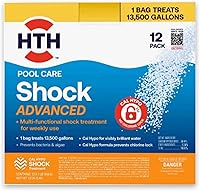
HTH 52037R: Best for saltwater systems
- Pool Care Shock Advanced, 12 Pack
- Cal Hypo formula with no added CYA
- Fast-dissolving 4-in-1 formula
- For vinyl-lined pools and saltwater systems
A 12 pack calcium hypochlorite shock that HTH makes for all pool types, including saltwater systems.
Pros
- No cyanuric acid added
- Targets bacteria and algae
- Weekly use formula
Cons
- 12 pack is a larger supply
- Powder needs dissolving before use
The HTH 52037R suits saltwater owners who shock weekly and want a formula that explicitly fits salt systems. HTH describes it as a fast-dissolving 4-in-1 formula that kills bacteria and algae, reduces chlorine odor and irritation, and restores clarity.
Its cal hypo base adds no cyanuric acid, so it avoids pushing stabilizer higher. That matters in a salt pool where you may already watch CYA for chlorine lock.
HTH says it can solve 90% of pool water problems within 24 hours with weekly use.
The 12 pack means you keep a steady supply on hand for a full season. Each bag is a pre measured dose you dissolve before adding, which helps even distribution.
HTH suggests testing twice weekly with 6-Way Test Strips.
Trade-off: the 12 pack is more than a first time buyer needs. If you only shock after storms, the 6 pack below may fit better.
For most weekly salt pool owners, this is the top pick.
HTH 52036R: Best for smaller saltwater pools
- Pool Care Shock Advanced, 6 Pack
- Cal Hypo formula with no added CYA
- Fast-dissolving 4-in-1 formula
- 6 x 1 lb package
The same HTH calcium hypochlorite formula as the 12 pack, in a 6 pack for lighter use.
Pros
- No cyanuric acid added
- Targets bacteria and algae
- Smaller supply than 12 pack
Cons
- Fewer bags if you shock weekly
- Powder needs dissolving before use
The HTH 52036R suits the same salt pool owner who wants the same formula in a smaller supply. It is the 6 pack version of the 12 pack above, packaged as 6 x 1 lb.
HTH uses the same cal hypo formula with no added CYA. It kills bacteria and algae and restores crystal clarity.
It is listed for all pool types, including saltwater systems and vinyl lined pools.
The 6 pack helps if you shock monthly rather than weekly. You still get pre measured bags and fast dissolving powder.
You avoid storing a full 12 pack if your pool is small or used lightly.
Trade-off: frequent shockers will run through 6 bags faster. The per season value of the 12 pack may suit heavy use better.
Choose this pack for trial use or light duty, and the 12 pack for weekly routines.
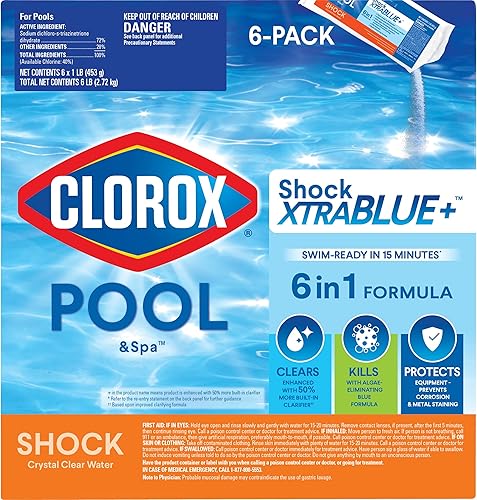
Clorox® Pool&Spa™ Shock XTRABLUE® Plus: Best for fast swim readiness
- 12-Pack granular shock
- Kills bacteria and algae
- Swim-ready in 15 minutes
- 1 lb per 12,000 gallons
A granular 6-in-1 shock with a stated dosage of 1 lb per 12,000 gallons and swim readiness in 15 minutes.
Pros
- Fast dissolving
- Algae fighting formula
- Clear dosage per gallon
Cons
- 12 pack suits frequent shockers
- Granular form needs distribution
The Clorox Shock XTRABLUE Plus suits owners who want speed and a clear dose. Clorox states 1 lb per 12,000 gallons and swim readiness in 15 minutes.
That stated swim time is the fastest claim in this group.
Its 6-in-1 formula kills bacteria and algae and destroys contaminants. Clorox says it aids filter performance and clears dull, cloudy water.
It is safe for vinyl, plaster, fiberglass and tile surfaces.
The 12 pack gives you weekly doses without reordering often. The granular form dissolves fast and needs no premixing.
Clorox suggests shocking weekly and after heavy use, high temperatures or rain, with the filter running.
Trade-off: Clorox does not state a cal hypo percentage here. If you want a high strength cal hypo specifically, compare the Doheny's option below.
For fast turnaround and dosage clarity, this Clorox pick is strong.
Clorox® Pool&Spa™ Shock Clear: Best for vinyl pools
- 6-Pack shock
- For crystal clear pool water
- Swim-ready in 15 minutes
- Suitable for vinyl pools
A 6 pack Clorox shock for removing contaminants that cause cloudy water and algae, suitable for vinyl pools.
Pros
- 6 pack size
- Weekly maintenance use
- Vinyl pool suitability
Cons
- No dosage stated in title data
- Smaller pack than 12 pack options
Clorox Shock Clear suits vinyl pool owners who want a 6 pack for routine care. Clorox positions it for crystal clear water and weekly maintenance.
It is listed as suitable for vinyl pools and swim-ready in 15 minutes.
Shocking helps remove contaminants that cause cloudy water and algae. That makes this a maintenance shock rather than a heavy algae treatment.
Use it as part of a regular routine, as Clorox suggests.
The 6 pack size fits smaller pools or owners who shock less often. Granules dissolve in the water with the filter running.
Keep the salt cell producing chlorine as normal while you maintain balance.
Trade-off: the title data gives no dosage per gallon. If you need exact dosing math, the Clorox XTRABLUE Plus and Doheny's options state it clearly.
Choose Shock Clear for vinyl friendly weekly care at a smaller pack size.
In The Swim Chlorine-Free Pool Shock: Best chlorine-free oxidizer
- 24 x 1 Pound Bags
- Chlorine-free shock oxidizer
- For salt chlorinated pools
- Quick dissolving, no pH change stated
A chlorine-free oxidizer in 24 one pound bags for standard chlorine, salt chlorinated, mineral and bromine pools.
Pros
- No added chlorine
- Works with salt chlorinated pools
- 24 pre measured bags
Cons
- Does not boost chlorine
- Large 24 bag supply
In The Swim Chlorine-Free Pool Shock suits salt pool owners who want oxidation without extra chlorine. The brand lists it for standard chlorine, salt chlorinated, mineral and bromine pools, plus spas and hot tubs.
It is a chlorine-free shock oxidizer in 24 x 1 pound bags. It dissolves quickly and, per the brand, does not raise or alter pH.
It enhances existing chlorine rather than adding more.
That trait helps if your salt cell already keeps chlorine steady. You can clear non-living matter and reduce odor without pushing free chlorine higher.
It also minimizes skin and eye irritation from chlorine byproducts, per the brand.
Trade-off: it will not boost chlorine when levels are low. If algae is active or chlorine is depleted, a cal hypo shock may be the better tool.
Choose this for weekly oxidizer use between salt cell cycles.
Doheny's Super Pool Shock: Best high strength cal hypo
- 24 x 1lb Bags
- 68% calcium hypochlorite
- 65% available chlorine
- 1 lb per 10,000 gallons
A pro grade granular cal hypo shock at 68% calcium hypochlorite, dosed at 1 lb per 10,000 gallons.
Pros
- High cal hypo strength
- Pre measured 1 lb bags
- Clear dosage per gallon
Cons
- 24 bag supply
- Strong chlorine boost needs testing
Doheny's Super Pool Shock suits owners who want maximum cal hypo strength. Doheny's states 68% calcium hypochlorite and 65% available chlorine.
That is the strongest stated strength in this group.
Dosage is clear: 1 lb per 10,000 gallons, with 2 to 3 doses for spring openings or heavy algae blooms. The 24 x 1 lb bags are pre measured, so no measuring is needed.
Granules dissolve quickly for fast acting sanitization.
This is a pro grade chlorine boost for salt pools that need to recover clarity fast. It instantly boosts chlorine to eliminate algae and contaminants, per Doheny's.
Test after application before swimming.
Trade-off: strength means care. Strong cal hypo can push chlorine high if you overdose.
Use the stated dose, run the filter, and test. For a light weekly oxidizer, the chlorine-free option is gentler.
{{compare}}
The table shows the real split in this group. Four picks add chlorine, one oxidizes without chlorine, and one leads on stated cal hypo strength.
| Product | Formula | Pack | Dose stated | Best fit |
|---|---|---|---|---|
| HTH 52037R | Cal hypo, no CYA | 12 | Weekly use | Salt systems |
| HTH 52036R | Cal hypo, no CYA | 6 | Weekly use | Smaller supply |
| Clorox XTRABLUE Plus | Granular shock | 12 | 1 lb per 12,000 gal | 15 minute swim ready |
| Clorox Shock Clear | Granular shock | 6 | Weekly routine | Vinyl pools |
| In The Swim | Chlorine-free | 24 | Weekly oxidizer | No chlorine boost |
| Doheny's Super | 68% cal hypo | 24 | 1 lb per 10,000 gal | Heavy algae or opening |
How we compared these salt pool shocks
We checked formula first, because salt pools already make chlorine daily. A shock that adds stabilizer or a shock that adds no chlorine changes your weekly balance in different ways.
We checked salt system compatibility next. HTH and In The Swim state salt system fit directly.
Clorox states surface compatibility and general pool use, which we weighed for salt pools that need surface safe granules.
We checked dosage clarity. Doheny's and Clorox XTRABLUE Plus give gallons per bag.
HTH and Clorox Shock Clear focus on weekly use, so we scored them on formula fit and pack size instead.
We also checked pack size against real use. Weekly shockers need 12 or 24 packs.
Light users get more value from 6 packs. Our scores reflect that match, not just strength.
Can you shock a saltwater pool? Yes, with the right type
Yes, you can shock a saltwater pool with a supplemental treatment. Your salt cell keeps making chlorine, and shock handles spikes that the cell alone cannot clear fast enough.
Salt pools still get algae after parties, heat waves and storms. Swimmer waste consumes chlorine quickly.
A shock oxidizes that waste and kills bacteria and algae that gain a foothold.
Learn the basics in our guide on can you shock a saltwater pool. It covers timing, testing and when to leave the cell running.
That guide pairs well with any pick here.
Shock with cal hypo when chlorine is low
Cal hypo shock raises free chlorine fast. Use it when chlorine has dropped, water looks dull, or algae has started.
Test before and after so you do not overshoot.
Use chlorine-free shock when chlorine is steady
Chlorine-free oxidizer clears contaminants without raising chlorine. Use it when your salt cell holds level but odor or dullness remains.
It protects pH balance while it oxidizes.
Should you use pool shock vs liquid chlorine in a salt pool?
Liquid chlorine and shock both add chlorine, but they do different jobs. Liquid chlorine maintains daily sanitizing level.
Shock provides a short, high dose to clear a spike.
Our breakdown of pool shock vs liquid chlorine explains when each fits. For salt pools, liquid chlorine is rarely the first choice because your cell already makes chlorine.
Shock is the supplement. Liquid chlorine is the backup if a cell is down or salt is low.
Keep shock for weekly or event based treatment, and let the cell handle the daily baseline.
What is the best pool shock for inground salt pools?
Most salt pools are inground, so volume matters more than pool shape. A 10,000 gallon pool needs less shock than a 30,000 gallon pool.
Always scale by gallons, not by eyeballing the surface.
Our best pool shock for inground pool guide covers in ground dosing in more depth. Use it alongside this salt specific roundup when your pool is inground and you want general shock advice too.
For salt inground pools, start with the HTH 12 pack if you shock weekly. Its no CYA formula keeps stabilizer from climbing season after season.
Step up to Doheny's if you face a heavy algae bloom at opening.
How do you dose and apply shock in a saltwater pool?
Run the pump while you add shock. Circulating water spreads granules evenly and prevents a concentrated dose in one spot.
Add shock to the deepest end with the filter running, per Clorox guidance.
Dissolve powder or granules as the label directs. Walk the dose around the pool in a slow pass.
Do not dump a full bag in one spot, especially with cal hypo formulas.
Test before you shock. Test again after the stated time.
Clorox XTRABLUE Plus states swim readiness in 15 minutes. Other shocks need their label wait time, so follow the bag you bought.
Keep the salt cell in normal operation unless the label says otherwise. Your cell will rebuild chlorine after the shock fades.
That return to baseline is the point of a supplement.
How does a robotic pool cleaner filter water? It is separate from shock
Shock clears chemistry problems. Your cleaner and filter handle debris and circulation.
They work together, but one does not replace the other.
If you are curious about filtration, read How Does a Robotic Pool Cleaner Filter Water?. It explains how cleaners trap debris while your salt cell and shock handle sanitation.
When should you shock after storms, parties or algae?
Shock after heavy use, high temperatures or rain, as Clorox suggests. Those events load the water with waste and contaminants.
A weekly shock also prevents most problems before they show.
Algae needs a stronger response. Brush walls and steps to expose algae to chlorine.
Apply the stated dose, and for heavy blooms Doheny's suggests 2 to 3 doses. Test between doses.
Also watch for water bugs in pool after warm storms. Bugs often signal organic matter in the water.
Shock plus brushing and filtration helps clear the conditions they feed on.
Should you shock at night or during the day?
Cal hypo shock works day or night. Chlorine-free oxidizer also works in daylight.
The key is circulation and your label wait time, not the hour.
UV can burn off chlorine during a sunny day. That is why many owners shock in late afternoon or evening.
If you shock in morning sun, test sooner and be ready to add chlorine if levels fall.
How do you choose between cal hypo and chlorine-free shock?
Choose cal hypo when you need more chlorine. Choose chlorine-free when chlorine is already where you want it.
That one question settles most of the decision.
Cal hypo adds CYA? No, HTH cal hypo adds no CYA.
That is a plus for salt pools worried about stabilizer. Doheny's cal hypo gives the highest stated strength for tough jobs.
Chlorine-free leaves pH and chlorine alone. In The Swim states quick dissolving with no pH change.
It suits salt pools where the cell holds level and you only need oxidation.
If your salt cell is weak, check a best pool salt cell replacement guide. A failing cell will force you to shock more often than needed.
Fix the cell first, then use shock as a supplement.
Verdict: which salt pool shock should you buy?
Buy the HTH 52037R 12 Pack if you shock weekly and want a salt system formula with no added CYA. It is the best match for the best pool shock for salt water pools search, because it targets bacteria and algae without raising stabilizer.
Buy the HTH 52036R 6 Pack if you want the same formula with fewer bags. It suits smaller pools, light use or a first trial.
Buy Clorox XTRABLUE Plus if 15 minute swim readiness matters most. Its dosage per 12,000 gallons is clear and it clears cloudy water fast.
Buy In The Swim Chlorine-Free if your salt cell already holds chlorine. It oxidizes without a chlorine boost and suits weekly maintenance.
Buy Doheny's Super if you need pro grade strength for opening or algae. Its 68% cal hypo and 1 lb per 10,000 gallons dose give you heavy duty power.
Pick by formula first, then pack size. Cal hypo for a chlorine boost and no CYA worries, chlorine-free for oxidation only, and high strength cal hypo for blooms.
Test, dose by gallons, run the filter, and let your salt cell return to daily duty.
Our top 3 picks at a glance
-
1
-
2
-
3
Best for fast swim readiness
Clorox® Pool&Spa™ Shock XTRABLUE® Plus
9.3/10 our score
See it on Amazon
Frequently asked questions
Can you shock a saltwater pool with regular pool shock?
Yes, you can shock a saltwater pool with a supplemental shock treatment. Choose a formula that is compatible with saltwater systems and follow the label dosage for your pool volume.
Run the pump and keep the salt cell in normal operation unless the label says otherwise.
How often should you shock a saltwater pool?
Many makers suggest weekly shocking and after heavy use, high temperatures or rain. Test the water first and shock when contaminants or clarity call for it.
A salt chlorine generator provides daily sanitizing, but it does not replace a periodic shock.
What is the difference between cal hypo shock and chlorine-free shock?
Cal hypo shock adds chlorine to sanitize and kill bacteria and algae. Chlorine-free shock oxidizes contaminants without adding chlorine.
Use cal hypo when you need a chlorine boost.
Use chlorine-free when you want oxidation without raising chlorine.
Do you need to turn off a salt cell when shocking?
Most owners leave the salt system running and shock as a supplement. Check the shock label for any salt cell instructions before you add it.
Keep the filter running so the granules disperse through the whole pool.