5 Best Pool Salt Cell Cleaners (November 2026)
The best pool salt cell cleaners include the EasyCare 22064 BeauTec Salt Cell and Tile for cell and tile buildup, the BioGuard Mineral Springs Cell Cleaner for Salt for quick cell soaks, and the MAV AquaDoc AquaDoc Salt Cell Cleaner for Saltwater for granular seasonal care.
On this page (9 sections)
- The best pool salt cell cleaners for scale and steady chlorine
- How do these salt cell cleaners compare side by side
- How we compared the best pool salt cell cleaner picks
- Liquid, granular or gallon pour: which form fits your routine
- What types of scale should a salt cell cleaner remove
- How long should you soak a salt cell and how do you rinse it
- When is cleaning not enough and the cell needs replacement
- How does salt cell care fit with the rest of pool care
- Which best pool salt cell cleaner should you buy
The best pool salt cell cleaner for most owners in this group is the EasyCare 22064 BeauTec Salt Cell and Tile Cleaner, because it combines cell scale removal with tile and surface care in one 64 oz liquid bottle. If your main job is a quick cell soak, BioGuard is a strong second pick.
If you prefer a granular cleaner you mix to strength, AquaDoc fits seasonal care.
Salt cell scale is a normal part of saltwater pool care. Calcium and other minerals build on plates over time.
That buildup can reduce chlorine output and make the cell work harder. A good salt cell cleaner for pools removes that scale without harsh acid handling.
It also helps you tell whether a weak output is a cleaning issue or a sign the cell needs replacement.
Our score weighs specs, features and buyer feedback against what you are shopping for. We compared size, form, soak time, stated scale types and whether a cleaner also helps tile or stains.
We also looked at how each option fits a normal routine, from a quick soak to a seasonal deep clean.
Our picks at a glance
-
1
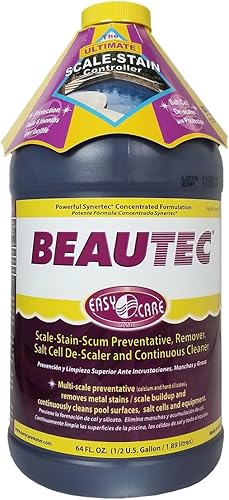 Best for cell and tile buildup
EasyCare 22064 BeauTec Salt Cell and Tile
9.7/10 our score
See it on Amazon -
2
 Best for quick cell soaks
BioGuard Mineral Springs Cell Cleaner for Salt
9.6/10 our score
See it on Amazon -
3
 Best for granular seasonal care
MAV AquaDoc AquaDoc Salt Cell Cleaner for Saltwater
9.4/10 our score
See it on Amazon
- 4
 Check it
EASYCARE Beautec Scale Remover & Salt Cell
Best for a two pack supply - 5
 Best for a gallon pourCheck it
The best pool salt cell cleaners for scale and steady chlorine
The top pick covers more jobs, while the other options focus on cell only care, mixing, value packs or volume. Start with the job you have in front of you.
Is the cell the only problem, or is tile scale and staining part of the same clean.
EasyCare 22064 BeauTec Salt Cell and Tile: Best for cell and tile buildup
- 64 oz liquid bottle
- Prevents scale, stain and scum buildup
- Removes existing buildup on surfaces and equipment
- Salt cell descaler and protector
A dual use liquid for salt cells and tile, in a larger 64 oz bottle for owners who see scale in more than one place.
Pros
- Covers cells and tile surfaces
- 64 oz bottle for repeat use
- Formulated to prevent scale and stains
Cons
- Larger bottle than cell only options
- Liquid form needs careful pouring and storage
EasyCare 22064 BeauTec suits owners who see scale on the cell and on tile at the same time. It comes as a 64 oz liquid bottle, so you have enough for repeat cell soaks plus tile work.
That size matters if you clean more than once in a season.
The formula is made to prevent scale, stain and scum buildup and to remove existing buildup on surfaces and equipment. EasyCare lists it as a salt cell descaler and protector that helps prolong cell lifespan.
That dual role is the main reason it ranks first here.
In daily use, a liquid is simple to pour and simple to store. You do not need to mix a granular cleaner or find a large bucket first.
The trade off is care in handling and storage. A 64 oz bottle takes more shelf space than a quart, and liquids need a secure cap and a place away from spills.
Choose this if tile lines, waterline scale and cell plates all need attention. See our fiberglass waterline cleaner guide for surface-cleaning options.
Choose BioGuard instead if you only need a cell soak and want a smaller quart bottle.
This is the most versatile pick in the group.
BioGuard Mineral Springs Cell Cleaner for Salt: Best for quick cell soaks
- 1 quart bottle
- Removes calcium carbonate, phosphate and sulfate scale
- Soak time 15 to 30 minutes
- For salt chlorine generators
A cell focused liquid cleaner for owners who want a short soak and a smaller quart size.
Pros
- Short 15 to 30 minute soak
- Targets several calcium scale types
- Quart size is easy to store
Cons
- Cell focused use
- Smaller total volume than 64 oz options
BioGuard Mineral Springs Cell Cleaner suits owners who want a focused cell cleaner with a short soak. It comes in 1 quart, which is easy to keep in a pool storage area.
That smaller size fits people who clean one cell and do not need tile care.
BioGuard says it removes calcium carbonate scale, calcium phosphate scale and calcium sulfate scale. That range of scale types is useful because not all buildup is the same.
The soak time is 15 to 30 minutes, so you can check plates, soak, rinse and refit in a short window.
The formula is made for salt chlorine generators and aims to prolong cell life with regular use. For daily routines, the short time helps.
You can plan a clean around a normal pool check rather than a full afternoon task.
The trade off against the top pick is scope. BioGuard is cell focused, while EasyCare covers tile and surfaces too.
If your tile line is clean and only plates need work, that focus is a plus. If tile scale is also present, the dual use option may save you a second product.
MAV AquaDoc AquaDoc Salt Cell Cleaner for Saltwater: Best for granular seasonal care
- 2 lb granular cleaner
- Mix 1 lb with 3 gallons of fresh water
- Soak plates for 15 to 30 minutes
- Made in the USA
A mix yourself granular cleaner for seasonal cell care, with a clear 1 lb to 3 gallon ratio.
Pros
- Long lasting granular form
- Clear mix ratio
- 2 lb size for seasonal use
Cons
- Requires mixing before use
- Needs a container large enough for 3 gallons
MAV AquaDoc AquaDoc Salt Cell Cleaner suits owners who prefer a granular cleaner for seasonal care. It comes in 2 lb, and the mix ratio is clear.
You mix 1 lb with 3 gallons of fresh water and soak plates for 15 to 30 minutes.
That granular form has real daily benefits. A powder or granular cleaner stores well and lets you mix only what you need.
The 2 lb size can cover more than one seasonal clean at the stated ratio. It also gives you control over strength and volume.
AquaDoc lists the cleaner for reducing mineral and calcium buildup on salt cell plates. It is made in the USA.
The maker presents it as part of regular saltwater system care, with use tied to your equipment maker instructions.
The trade off is set up. You need a container that can hold 3 gallons, plus time to mix and dissolve.
Liquid options are faster to start. Choose AquaDoc if you like a seasonal routine and do not mind mixing.
Choose a liquid if you want the fastest start.
EASYCARE Beautec Scale Remover & Salt Cell: Best for a two pack supply
- 32 fl oz 2 pack
- 64 fluid ounces total
- Removes scale without harsh acids
- Prevents metal stains from iron, copper and manganese
The same BeauTec formula split into two 32 oz bottles, which suits owners who want a spare bottle on hand.
Pros
- Two bottles for storage
- Same 64 oz total volume
- Covers scale and metal stains
Cons
- Two pods to track
- Less simple than one larger bottle
EASYCARE Beautec Scale Remover and Salt Cell Cleaner suits owners who want the BeauTec formula in two smaller bottles. This pack has two 32 fl oz bottles, for 64 fluid ounces total.
That split can help if you want one bottle in the pool area and one spare in storage.
The formula removes existing scale buildup without harsh acids. It also helps prevent metal stains linked to iron, copper and manganese.
EasyCare says it guards against softer calcium scale and harder calcium silicate scale. That stain and scale mix makes it useful beyond plates alone.
In daily use, two bottles mean two caps to track and two places to store. Some owners like that split because a single open bottle is less likely to run out mid season.
Others prefer one large bottle for fewer parts.
The trade off against the top pick is convenience. The top pick is one 64 oz bottle.
This pack is the same total volume in a different format. Choose the two pack if a spare bottle helps your routine.
Choose the single bottle if you want the simplest storage.
Generic Salt Cell Cleaner: Best for a gallon pour
- 1 gallon size
- Removes calcium scale, oils, lotions and grime
- Pour into cell and let stand until deposits dissolve
- No dyes, phosphates or optical brighteners
A gallon pour in cleaner for owners who prefer one large container and a gentle cell formula.
Pros
- Large 1 gallon volume
- Handles oils and lotions as well as scale
- Simple pour and stand method
Cons
- Largest container to store
- Generic branding with fewer size choices
Generic Salt Cell Cleaner, sold as Guardian, suits owners who want a large gallon pour. It comes in 1 gallon, which is the largest volume in this group.
That size helps if you clean often or share pool care with family help.
The cleaner removes calcium scale, oils, lotions, grime and makeup. That wider list matters in real pools.
Sunscreen, lotions and oils can coat plates along with mineral scale, so a cleaner that targets both can help when a cell looks dull rather than chalky.
The method is simple. You pour it into the cell and let it stand until deposits dissolve.
Guardian is described as very gentle on the cell. It has no dyes, phosphates or optical brighteners.
The goal is to restore cell elements to regular chlorine production.
The trade off is storage and brand choice. A gallon container takes more space and is heavier to move when full.
This option also has fewer format choices than the branded picks. Choose it if volume and a broad clean list matter most.
Choose a smaller bottle if storage space is tight.
How do these salt cell cleaners compare side by side
The comparison is simple. EasyCare 22064 is the dual use 64 oz liquid for cells plus tile.
BioGuard is the 1 quart cell soak with a 15 to 30 minute time. AquaDoc is the 2 lb granular cleaner mixed at 1 lb per 3 gallons.
The EasyCare two pack splits 64 oz into two 32 oz bottles. Guardian is the 1 gallon pour.
| Product | Best for | Size | Form | Model | Our score |
|---|---|---|---|---|---|
| EasyCare 22064 BeauTec Salt Cell and Tile | cell and tile buildup | 64 oz bottle | Liquid | 22064 | 9.7 |
| BioGuard Mineral Springs Cell Cleaner for Salt | quick cell soaks | 1 quart | 23242BIO | 9.6 | |
| MAV AquaDoc AquaDoc Salt Cell Cleaner for Saltwater | granular seasonal care | 2 lb | Granular | 9.4 | |
| EASYCARE Beautec Scale Remover & Salt Cell | a two pack supply | 32 fl oz 2 pack | Liquid | 22064 | 9.1 |
| Generic Salt Cell Cleaner | a gallon pour | 1 gallon | Liquid | 8.8 |
How we compared the best pool salt cell cleaner picks
We compared the five options by use, size, form and soak method. We checked whether each cleaner targets cell plates only or also helps tile, stains and surface scale.
We also checked stated scale types, such as calcium carbonate, calcium phosphate, calcium sulfate and calcium silicate.
Size changes daily use more than most buyers expect. A quart is easy to store and may be enough for a few cell soaks.
A 64 oz bottle gives more room for repeat use. A gallon gives the most volume but asks for more storage space.
A 2 lb granular cleaner gives control, but it requires mixing and a large enough container.
Buyer feedback also shaped the order. Options with clear instructions and a focused job tend to fit better.
A cleaner that promises tile, stain and cell care can score higher for owners with mixed buildup. A cell only cleaner can score higher for owners who want a short, simple soak.
We did not test these products by hand. We research specs and buyer patterns, then rank each option for the search job.
That means our scores reflect fit for a salt cell cleaner search, not a lab test result.
Liquid, granular or gallon pour: which form fits your routine
A liquid cleaner is the fastest form for most owners. You open the bottle, pour or soak, wait, then rinse and refit.
EasyCare 22064 and BioGuard both use this form. Liquids suit people who want a quick monthly check and clean.
A granular cleaner suits seasonal care. AquaDoc asks you to mix 1 lb with 3 gallons of water.
That step takes more time, but it gives you a large soak volume and a form that stores well. It fits owners who plan a deeper clean at opening or closing.
A gallon pour sits between those needs. Guardian gives a large volume for owners who clean often or dislike running out.
The pour and stand method is simple, but storage is the price. A full gallon is bulky in a small pool shed.
Liquid cleaners for quick soaks
Liquids work best when you check the cell often. A short soak fits a normal pool visit.
EasyCare 22064 also helps tile, which can turn one bottle into a wider clean. BioGuard keeps the job focused on the cell.
Granular cleaners for seasonal mixing
Granular cleaners reward planning. You mix once, soak plates for 15 to 30 minutes, then rinse.
The AquaDoc ratio gives a clear starting point. That clarity helps if you are new to saltwater care and want set steps.
Gallon options for frequent use
A gallon pour helps if you clean more than a few times a year or if oils and lotions coat plates often. Guardian lists oils, lotions and grime along with calcium scale.
That mix matches pools with heavy swimmer use in warm months.
What types of scale should a salt cell cleaner remove
Scale is not one single deposit. BioGuard lists calcium carbonate, calcium phosphate and calcium sulfate.
EasyCare lists softer calcium scale and harder calcium silicate scale. That difference matters because hard scale can be tougher to clear.
White chalky deposits on plates often point to calcium scale. Dull plates with a film may point to oils or lotions.
Metal stains are a separate issue, but EasyCare BeauTec links stain prevention to iron, copper and manganese. That is why a dual use cleaner can help beyond the cell.
Check your plates in good light before you clean. Note whether the buildup is chalky, flaky, oily or stained.
That note helps you choose a cleaner and judge the result after rinsing. If the plates look clean but output is still low, the issue may be cell age or another system part.
Our pool salt sensor guide can help if readings look off after cleaning. Cleaning restores plates, but a sensor fault can still cause false readings.
It helps to solve one part at a time.
How long should you soak a salt cell and how do you rinse it
Two picks here use a 15 to 30 minute soak. BioGuard lists 15 to 30 minutes.
AquaDoc lists 15 to 30 minutes after mixing 1 lb with 3 gallons of water. That shared range is a useful guide for cell care.
Follow the label for your cleaner. Turn off the pump and generator as directed by your equipment manual.
Remove the cell, inspect the plates, then soak only as long as the label states. Rinse well and refit the cell before you restart the system.
Do not assume a longer soak is better. Some deposits clear in the stated time.
Extra time can waste your pool day and may not add cleaning power. If scale remains, you may need a second soak or a different cleaner for the scale type you see.
If you are still planning the salt system, our how to convert a pool to salt water guide explains start up and care in plain steps. It also helps you set a cleaning routine from day one.
When is cleaning not enough and the cell needs replacement
Cleaning helps when scale is the problem. It does not fix worn plates, a failing board or a sensor fault.
If chlorine output stays low after a proper clean, check the salt level, flow and cell age. Then check whether the cell has reached its expected life.
This is the point where many owners waste money on repeat cleans. A clean cell that still cannot hold chlorine may need attention elsewhere.
Check the generator output, the cell connection and the water balance before you buy chemicals for a fix that cleaning cannot provide.
Our best pool salt cell replacement guide helps you compare replacement cells by fit and output. It also explains when replacement is the better next step.
Keep the cost of a new cell in mind before you buy a large cleaner supply for a dying cell.
How does salt cell care fit with the rest of pool care
Salt cell care is one part of pool care. Water balance, filtration and debris control all affect how fast scale builds.
Our swimming pool chemicals guide covers the wider chemical routine, including the balance checks that help protect plates.
Automatic cleaners also affect water quality. Our How Do Automatic Pool Cleaners Work? page explains how circulation and cleaning help keep debris from sitting on surfaces.
Cleaner water can mean less debris load on the cell and filter.
Robotic cleaners filter water as they move. Our How Does a Robotic Pool Cleaner Filter Water? page explains that flow path.
Better debris pickup can support clearer water, which helps you judge cell condition faster.
Start up care matters too. Our best pool start up chemicals guide covers the first balance steps after opening or filling.
A good start helps you avoid heavy scale in the first weeks.
If you are choosing the generator that feeds the cell, our best pool salt chlorine generator guide compares generator options. A matched generator and cell pair makes later cleaning simpler.
Which best pool salt cell cleaner should you buy
Pick EasyCare 22064 BeauTec if tile scale, stains and cell scale all need work. Pick BioGuard if you want a 1 quart cell soak in 15 to 30 minutes.
Pick AquaDoc if you prefer a granular seasonal mix at 1 lb per 3 gallons. Pick the EasyCare two pack if a spare 32 oz bottle helps your storage.
Pick Guardian if a 1 gallon pour and broad grime removal fit your routine.
Match the cleaner to the deposit you see. Chalky scale, oily film and metal stains are not the same job.
Check plates, read the label, soak for the stated time and rinse well. That simple routine will keep most salt cells working longer.
Our top 3 picks at a glance
-
1
Best for cell and tile buildup
EasyCare 22064 BeauTec Salt Cell and Tile
9.7/10 our score
See it on Amazon -
2
Best for quick cell soaks
BioGuard Mineral Springs Cell Cleaner for Salt
9.6/10 our score
See it on Amazon -
3
Best for granular seasonal care
MAV AquaDoc AquaDoc Salt Cell Cleaner for Saltwater
9.4/10 our score
See it on Amazon
Frequently asked questions
How often should you clean a salt cell?
Clean a salt cell when you see white scale on the plates or when chlorine output drops. Many owners check monthly and clean seasonally.
Follow your generator maker schedule, since cell type and water hardness change how fast scale builds.
Can you use tile cleaner on a salt cell?
Some dual use cleaners are made for both tile and cells, such as the EasyCare BeauTec options here. Read the label for cell use before you soak plates.
A tile only product may not be safe for cell plates, so check the stated use first.
How long should a salt cell soak?
Two strong options here list 15 to 30 minutes. BioGuard lists 15 to 30 minutes, and AquaDoc lists 15 to 30 minutes after mixing 1 lb with 3 gallons of water.
Longer soaks do not always clean better, so follow the label time for your cleaner.
What causes scale on a salt cell?
Hard water and high calcium levels leave mineral deposits on cell plates. Heat and chlorine production speed up buildup.
Regular checks and timely cleaning help keep plates clear and support steady chlorine output.
When should you replace a salt cell instead of cleaning it?
Replace a cell when cleaning no longer restores chlorine output or when plates show wear. Check our guide to the best pool salt cell replacement before you buy a new cell.
Cleaning helps with scale, but it cannot fix a worn cell.