How to Choose a Pool Filter Cleaning Stand
The right pool filter cleaning stand supports your cartridge without covering the pleats, drains dirty water away, and fits the cartridge's length and diameter. Match the stand to your filter size, hose position and cleaning area before buying.
On this page (11 sections)
- What does a pool filter cleaning stand do?
- How do you measure a cartridge for a cleaning stand?
- Which stand shape works best for cartridge cleaning?
- How should drainage affect your choice?
- What should you use with a pool filter cleaning stand?
- How do you use a stand when rinsing a cartridge?
- When should you soak a cartridge instead of rinsing it?
- What mistakes should you avoid with a filter cleaning stand?
- Does a filter stand replace the pool filter?
- How do you care for a cartridge after cleaning?
- What is the best way to choose a pool filter cleaning stand?
The right pool filter cleaning stand keeps a cartridge upright, supports its weight without crushing the pleats, and lets dirty water drain away. Measure the cartridge first, then choose a stand with enough room for the full length and diameter.
A stand is useful because cartridge cleaning involves more than spraying the outside. You need access to the pleats, a stable base, room for a hose or soak bucket, and a way to keep dirty water away from the clean cartridge.
The stand itself does not clean the filter. It holds the cartridge in a position that makes rinsing, inspection and drying easier.
What does a pool filter cleaning stand do?
A pool filter cleaning stand supports a cartridge while you rinse between the pleats or prepare it for a chemical soak. Its main job is positioning and drainage, not filtration or chemical cleaning.
A cartridge is easier to clean when it stays upright. You can work from the top toward the bottom, rotate the cartridge as needed, and see whether dirt is still trapped between the folds.
A good stand also reduces handling. Lifting a wet cartridge repeatedly can make the work awkward, especially when the filter is long or heavy with water.
Use a stand in a location where dirty water can run to a suitable drain or collection area. Pool chemicals and dirty rinse water should not be allowed to flow into areas where children, pets or plants may be exposed.
The pool pumps and filters complete buying guide explains how the filter fits into the wider pool circulation system.
How do you measure a cartridge for a cleaning stand?
Measure the cartridge's length, outside diameter and bottom opening before choosing a pool filter cleaning stand. These measurements matter more than a general label such as “pool filter stand.”
Remove the cartridge from the filter housing and let it drain. Measure the main cylindrical body, not the handles or end caps that extend beyond the pleated section.
Record these measurements:
- Overall cartridge length
- Outside diameter
- Diameter and shape of the bottom opening
- Width of the top handle or top opening
- Any unusual end-cap shape
- Approximate wet weight when lifted
A stand needs to support the cartridge without pressing hard against the pleats. If the support ring is too narrow, the cartridge may wobble or rest on its pleated fabric.
If it is too wide, the filter may lean while you spray it.
The height also matters. A tall cartridge may need a stand with a broad base, while a short spa cartridge can be easier to hold in a compact support.
If you cannot measure the cartridge directly, use its model number to find the manufacturer's dimensions. Do not assume that cartridges from the same brand share one size.
Which stand shape works best for cartridge cleaning?
An open, stable stand is usually the most useful design for cartridge cleaning. Choose a support that holds the end caps while leaving the pleated surface exposed to water.
Look for these design features:
| Stand feature | Why it helps |
|---|---|
| Wide base | Reduces tipping when the cartridge is wet |
| Open sides | Gives the hose access to the pleats |
| Raised support | Keeps the bottom out of dirty runoff |
| Drainage gaps | Help water and cleaning solution escape |
| Non-slip feet | Limit movement on wet paving |
| Smooth contact points | Reduce the risk of scraping end caps |
| Enough height | Helps you reach the lower pleats |
| Room to rotate | Makes full rinsing easier |
A stand with solid walls can block the spray pattern. It may still hold the cartridge, but you may need to move the filter more often to reach all sides.
A very narrow holder can be stable but difficult to use with wide cartridges. A very wide holder may accept several sizes but provide less lateral support.
The best pool filter cleaning stand is not necessarily the tallest or largest model. It is the one that matches the cartridge and keeps the working area controlled.
How should drainage affect your choice?
Choose a stand that keeps dirty water moving away from the cartridge. Drainage matters because trapped runoff can carry loosened debris back onto clean pleats.
An open base lets water fall through instead of pooling under the bottom cap. Slatted supports, raised rails and perforated platforms can all help, provided they remain stable under the cartridge's wet weight.
Think about where the water will go. A stand with excellent drainage is still inconvenient if it leaves runoff beside a wall, across a walkway or near electrical equipment.
For hose cleaning, place the stand on a surface that can handle water. A gravel area, utility drain or suitable wash space may work better than a smooth patio where dirty water spreads.
For chemical soaking, drainage has a different role. The cartridge usually sits in a bucket or container during the soak, so the stand may be used before and after soaking rather than inside the solution.
Follow the product label for any cleaner you use. The how to clean a pool filter guide covers the general sequence of removing debris, cleaning the media and returning the filter to service.
What should you use with a pool filter cleaning stand?
Use a stand with a hose sprayer for routine debris removal, then use a compatible soak cleaner when oils, lotion and grime remain. The stand improves access, while the cleaner handles deposits that water alone may not remove.
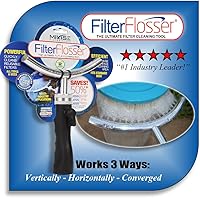
The Ultimate Cartridge Filter Cleaner for Pools is made by Filter Flosser and has a 100% aluminum nozzle. Its curved nozzle is designed to concentrate water between pleats, and the handle includes an on/off switch.
The tool is described for pool and spa filters, as well as HEPA and performance air filters. Its dimensions are 7 x 1.5 x 9 in and its weight is 9.9 oz, so it is a compact option for a cleaning area where storage space matters.
The product description says the spray pattern can help reduce water use while directing impact between the pleats. It connects to a regular garden hose, so you still need a stable water source and a place for runoff.
Spa Depot Power Soak Hot Tub & Pool is a granular cleaner with enzymes for pleated hot tub and pool filter cartridges. The package contains 2 bottles, with a total product weight of 2 lb.
The supplied use direction is to dissolve 1/2 cup in a 5-gallon bucket of hot or cold water. Hot water can reduce soak time, while thorough rinsing is needed before the cartridge returns to the pool or spa.
This cleaner suits a routine where rinsing removes leaves and hair first, then soaking addresses oils, lotions and soap residue. It does not replace the need for a stand, because you still need a stable place to inspect and rinse the cartridge before and after the soak.
MAV AquaDoc AquaDoc Hot Tub & Pool Filter is a 64 oz filter cleaner soak. Its product information describes use with cartridge, sand and diatomaceous earth filters and gives a 60-minute soak time.
The cleaner is made by MAV AquaDoc and has a 4 lb item weight. Its dimensions are 3 x 3 x 9 in, which may make storage easier beside other pool maintenance supplies.
This option fits a cleaning routine that values a shorter stated soak period. Confirm that the product suits your filter type and follow its directions before rinsing the cartridge thoroughly.
How do you use a stand when rinsing a cartridge?
Place the stand on a stable surface, set the cartridge upright, and rinse from the top toward the bottom. A slow downward spray helps move loosened dirt out of the pleats instead of pushing it deeper into the cartridge.
Start by shutting off the pool pump and releasing pressure from the filter housing. Remove the cartridge carefully and inspect it for tears, crushed pleats or damaged end caps.
Set the cartridge on the stand with the bottom supported. Keep the stand steady before turning on the hose.
Hold the spray at an angle rather than pointing straight into the pleats. Work around the cartridge in sections, moving from the top down and rotating the filter as you go.
Do not force a high-pressure jet into the media. Excessive pressure can damage pleats or drive debris farther into the folds.
Rinse the top and bottom end caps separately. Dirt around the end caps can fall back onto clean pleats if you leave those areas until after the main rinse.
When the water leaving the cartridge is clear, inspect the pleats again. A stand makes it easier to see missed sections because the cartridge remains upright and accessible.
When should you soak a cartridge instead of rinsing it?
Soak a cartridge when rinsing removes loose debris but leaves greasy residue, body oils, lotion or soap film. Rinsing and soaking solve different problems, so many cleaning routines use both.
Begin with a hose rinse to remove leaves, hair and larger particles. Large debris can interfere with a chemical cleaner and reduce the available surface area.
Prepare the soak in a bucket or container that can hold the cartridge without bending it. Use the cleaner's stated amount, water temperature and soak time.
After soaking, rinse the cartridge until no cleaner remains. Residual cleaner can affect pool or spa water and may create unwanted foam or water quality problems.
Let the cartridge dry fully before storing it. Dry storage helps prevent the damp filter from sitting in a closed container with leftover moisture.
The homemade pool filter cartridge cleaner guide covers simple cleaning approaches, while the best pool filter cartridge cleaner guide compares cleaner types for different residue problems.
What mistakes should you avoid with a filter cleaning stand?
Avoid using a stand that lets the cartridge wobble, blocks access to the pleats or leaves the filter sitting in dirty runoff. Poor positioning can make a careful rinse less effective and may damage the cartridge.
Common mistakes include:
- Choosing a stand before measuring the cartridge
- Resting the pleats directly on a rough surface
- Spraying so hard that the fabric folds or tears
- Cleaning on a slope where the cartridge can fall
- Letting dirty water pool around the bottom cap
- Using household degreasers or cleaners not made for filter media
- Returning the cartridge before it is fully rinsed
- Storing the cartridge while it is still wet
- Ignoring a torn pleat or damaged end cap
- Forgetting to release filter pressure before removal
A stand cannot repair a damaged cartridge. Replace a filter when the pleats, end caps or core no longer remain in usable condition.
Do not judge a cartridge only by how clean the outer surface looks. Dirt can remain deep between folds, especially when the spray angle is too shallow or the cartridge is not rotated.
For the full cartridge process, read how to clean a cartridge pool filter.
Does a filter stand replace the pool filter?
A cleaning stand does not replace the pool filter, and an automatic cleaner does not replace the filter either. The stand supports maintenance, while the pool filter removes suspended debris from circulating water.
A pool filter remains part of the circulation system. It catches particles after water passes through the pump and before the water returns to the pool.
A robotic cleaner may collect debris from the pool floor and walls, but it works on a different part of the maintenance routine. Read how a robotic pool cleaner filters water for that distinction.
The guide on why an automatic cleaner does not replace the pool filter explains why both systems can have useful roles.
Keeping the cartridge clean helps the filter work as intended, but it does not remove the need to monitor pressure, inspect the housing and replace worn cartridges.
How do you care for a cartridge after cleaning?
After cleaning, rinse away all residue, drain the cartridge and let it dry before storing it. A clean, dry cartridge is easier to inspect and less likely to sit in trapped moisture.
Stand the cartridge vertically or place it where air can circulate around the pleats. Keep it away from direct contact with mud, leaves and other sources of fresh debris.
Store the filter where it will not be crushed by heavy equipment. Keep end caps supported and avoid stacking objects against the pleats.
If you rotate between cartridges, label them by date or position. This makes it easier to notice when one filter needs cleaning more often than another.
Inspect the cartridge before reinstalling it. Look for split pleats, loose bands, damaged end caps and cracks around the core.
When reinstalling, check that the cartridge is seated correctly in the housing. Close the lid evenly and confirm that the system is sealed before restarting the pump.
Use a replacement cartridge that matches the filter housing. The best replacement pool filter cartridges guide can help you compare replacement choices.
What is the best way to choose a pool filter cleaning stand?
Choose a pool filter cleaning stand by matching the cartridge dimensions first, then checking support, drainage and access for your cleaning method. A stand that fits the filter but leaves it unstable will create more work.
Pick a broad, open support if you clean large pool cartridges with a hose. Choose a smaller support only when it holds a spa cartridge securely without covering the pleats.
If your cartridge often has oily residue, plan for a stand plus a compatible soak cleaner. If the problem is mostly leaves and dirt, a hose tool with a directed spray may be enough for routine rinsing.
The best match is the stand that keeps the cartridge upright, gives you room to work around every pleat and sends dirty water away from the clean filter. Measure first, then choose the support that fits your cartridge rather than buying by the general product name.
Frequently asked questions
What is a pool filter cleaning stand used for?
A pool filter cleaning stand holds a cartridge upright while you rinse or soak it. The best design keeps the pleats open to water, supports the cartridge without crushing it, and lets dirty water drain away from the clean work area.
How do I choose the right size pool filter cleaning stand?
Measure the cartridge's length, outside diameter and bottom opening before choosing a stand. The support should hold the cartridge securely without blocking the pleats or forcing the filter into a tilted position.
Can I clean a cartridge filter without a stand?
You can clean a cartridge filter without a stand, but a stand makes the work easier and keeps the cartridge upright. If you clean on the ground, protect the pleats from grit and make sure dirty rinse water can run away.
Should a pool filter cleaning stand have drainage?
Yes, drainage helps carry dirt, algae and cleaning solution away from the cartridge. Look for an open base, slatted support or another design that does not leave the cartridge sitting in its own dirty water.
Can I use a cleaning stand with a spa filter?
You can use a cleaning stand with a spa filter if the cartridge fits the support area and the stand remains stable. Smaller spa cartridges may need a narrower holder than a full-size pool cartridge.