9 Best Calcium Hypochlorite Pool Shock (November 2026)
The best calcium hypochlorite pool shock include the HTH 52037R for weekly no-CYA shocks, the HTH for weekly shocks with test strips, and the In The Swim Pool Shock (best bulk 50 lb value).
On this page (10 sections)
- How we compared these cal hypo pool shocks
- The best calcium hypochlorite pool shocks for pool maintenance
- How do cal hypo shock strengths compare?
- What is cal hypo pool shock and when should you use it?
- How much cal hypo shock do I use per gallon?
- Cal hypo vs other shock types: which should you use?
- Which cal hypo shock fits your pool type?
- How do you use cal hypo shock safely?
- More guides on this topic
- Final verdict: which cal hypo shock should you buy?
The best calcium hypochlorite pool shock for most pool owners is the HTH 52037R, because its Cal Hypo formula works weekly, dissolves fast and adds no cyanuric acid. If you own a large pool, a 68% bulk bucket will cost less per treatment.
If you hate measuring, pre-measured 1 lb bags are worth the extra cost.
Cal hypo is a granular chlorine shock, not a daily sanitizer. It spikes free chlorine to kill bacteria and algae, clear cloudy water and remove swimmer waste.
Our score weighs specs, features and buyer feedback against what you are shopping for. Strength, pack size, dosage clarity and pool compatibility drove the ranking.
Start with your pool size and surface type. Our guide to swimming pool chemicals helps you place shock within a full routine.
Then pick a pack format you will actually use every week.
Our picks at a glance
-
1

-
2

-
3

- 4
 Check it
Clorox® Pool&Spa™ Shock XTRABLUE® Plus
Best for fast swim-ready return - 5
 Best pre-measured 1 lb bagsCheck it
- 6
 Best for vinyl poolsCheck it
- 7
 Best pro-grade 68% bagsCheck it
- 8
 Check it
POOL SHARK 68% Calcium Hypochlorite Pool Shock
Best 50 lb bucket for big pools - 9
 Check it
EZ POOLS Super Shockwave Pool Shock
Best 73% strength bucket
How we compared these cal hypo pool shocks
We compared stated strength, available chlorine, pack format, dose per gallon and compatibility claims. We checked whether each option adds CYA, how it dissolves and what bag size it uses.
We looked at 68% products against a 73% option, and at buckets against 1 lb bags. Bulk buckets suit large pools, while bags suit smaller pools and owners who want no measuring.
Buyer patterns matter too. Owners of large inground pools often mention bulk value, while above ground owners often prefer a small pack.
We weighted those patterns in the scores.
Dose, dissolution and compatibility were the deciding factors
We treated dose clarity as a safety issue, not just convenience. A product that states 1 lb per 10,000 gallons or 1 lb per 12,000 gallons lets you plan a weekly routine without guesswork.
A product with less specific dose detail requires more care on the label before you buy.
Dissolution speed matters for liners and for filter performance. Fast dissolving powder or granules spread more evenly in the deepest part of the pool.
Slow or uneven dissolution raises the risk that granules sit on a surface and bleach it.
Compatibility claims also shaped the scores. Vinyl, plaster, fiberglass, tile, Gunite, saltwater systems, spas and hot tubs are not interchangeable in practice.
We credited products that named the surfaces they support, and we checked whether pre dissolving was advised for liner protection.
We also compared how each format fits a real season. A 6 pack may suit a small above ground pool that shocks after parties, but it will run out quickly in a large inground pool.
A 50 lb bucket reverses that logic, offering strong value per gallon while demanding storage, a scale and a steady weekly habit.
The best calcium hypochlorite pool shocks for pool maintenance
The picks below cover weekly maintenance, heavy algae blooms and different pool types. Each write-up explains who the product suits and what trade-off to expect.
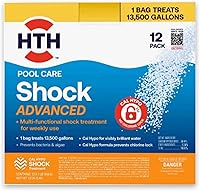
HTH 52037R: Best for weekly no-CYA shocks
- Cal Hypo based formula
- Fast-dissolving powder
- No added cyanuric acid
- 12 bags, 16 ounces per bag
A 4-in-1 Cal Hypo shock for weekly use when you want clarity restored without adding CYA.
Pros
- No added CYA
- Fast-dissolving
- Suits vinyl and saltwater pools
Cons
- Smaller bags mean more frequent reordering for large pools
HTH 52037R suits owners who shock weekly and want to avoid adding stabilizer. Its Cal Hypo formula sanitizes without cyanuric acid, which helps prevent overstabilization over time.
The 12 pack uses powder bags that dissolve fast. HTH describes a 4-in-1 treatment that kills bacteria and algae, reduces chlorine odor and restores clarity.
It states compatibility with all pool types, including vinyl-lined pools and saltwater systems, so it covers most residential setups without a separate check.
HTH positions this as a multi functional weekly treatment that can solve most pool water problems within 24 hours. In daily use that means one routine dose for dull water after heavy use, rain or heat, rather than reaching for several different products.
The trade-off is bag size and total quantity. The listed package weight is 16 ounces, and large pools may need more than one bag per shock.
A 20,000 gallon pool could move through 12 bags in only a few weeks.
Choose it for simplicity and no-CYA weekly care. Choose a bulk bucket instead if you have a large pool and want lower cost per dose.
HTH: Best for weekly shocks with test strips
- Cal Hypo formula
- 15 1-lb bags
- 15 test strips included
- 1 bag treats 13,500 gallons
Pre-measured 1 lb bags plus test strips make weekly free chlorine checks easier.
Pros
- Test strips included
- 1 bag treats 13,500 gallons
- Won't fade vinyl liners
Cons
- Bulk buyers may prefer a bucket
HTH 52046 suits owners who want test strips included with their shock. The 15 pack contains 15 1-lb bags and 15 test strips, so you can check free chlorine as you go.
Each 1 lb bag treats 13,500 gallons. HTH says to shock weekly and keep free available chlorine between 1 and 4 ppm.
It states use for pools with liners, Gunite pools and saltwater systems. HTH also says it will not fade vinyl pool liners when used as directed.
In daily use the included strips match the weekly rhythm. You shock, wait for the stated results window, then test before swimming.
That pairing is useful if you do not already own a liquid test kit or a set of strips.
The trade-off is value. You pay for convenience and strips, not bulk pricing.
Large pools may still need multiple bags per treatment, and 15 bags can disappear in a season of weekly shocks.
Choose it if you want a ready weekly kit. Skip it if you already test with a liquid kit and want the cheapest shock per pound.
In The Swim Pool Shock: Best bulk 50 lb value
- 68% Cal-Hypo granular sanitizer
- 65% available chlorine
- 50 pounds
- 1 lb per 10,000 gallons weekly
A 50 lb bucket of 68% Cal-Hypo for large pools and season-long weekly use.
Pros
- High 68% strength
- Low running cost per gallon
- Pre-dissolve to protect liners
Cons
- Large bucket needs dry storage space
In The Swim 50 lb suits large inground pools and owners who shock every week. The 68% Cal-Hypo granular sanitizer provides 65% available chlorine.
Dosage is 1 lb per 10,000 gallons weekly to maintain 5 to 10 ppm chlorine. That clear dose makes planning easy for pools of 15,000 to 30,000 gallons.
You should pre-dissolve or dilute the granules to avoid bleaching a liner. Spread granules in the deepest part and brush if needed.
In daily use this is a season supply rather than a single treatment. You measure a pound at a time, dissolve it, and apply it with the filter running.
The high available chlorine means a modest weight delivers a strong shock for cloudy water or algae pressure.
The trade-off is storage. A 50 lb bucket needs a dry, safe place away from kids and pets.
You also need a scale to measure each dose, and opening a large bucket in a small shed takes planning.
Choose it for season-long value. Choose 1 lb bags if storage space is tight or measuring feels like a hassle.
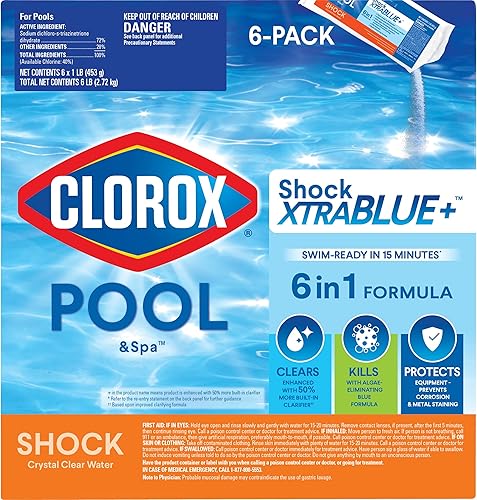
Clorox® Pool&Spa™ Shock XTRABLUE® Plus: Best for fast swim-ready return
- 6 in 1 granular formula
- Swim-ready in 15 minutes
- 1 lb per 12,000 gallons
- 12 pack, 12 pounds
A fast-dissolving 12 pack aimed at weekly shocks and a quick return to swimming.
Pros
- Fast-dissolving
- 1 lb treats 12,000 gallons
- Safe for vinyl, plaster, fiberglass and tile
Cons
- Higher cost per pound than bulk buckets
Clorox Shock XtraBlue Plus suits owners who want a fast return to swimming. It is a granular 6-in-1 formula that kills bacteria and algae and helps clear dull, cloudy water.
The 12 pack uses 1 lb per 12,000 gallons. Clorox says you can swim in 15 minutes after application when you follow label directions.
It states safety for vinyl, plaster, fiberglass and tile surfaces. That covers the most common residential pool finishes.
In daily use the speed claim is the main difference. You can shock after a party or a hot weekend and plan to swim the same afternoon, rather than waiting a full day.
The formula also aims to destroy contaminants that can dull water and burden the filter.
The trade-off is cost per pound compared with bulk Cal-Hypo. You are paying for speed, bag convenience and the app support Clorox mentions for testing and dosage advice.
Choose it for weekly party-season shocks and quick turnarounds. Choose bulk 68% if you want the lowest cost per gallon.
In The Swim Pool Shock: Best pre-measured 1 lb bags
- 68% Cal-Hypo granular sanitizer
- 65% available chlorine
- 24 x 1 pound bags
- 1 lb per 10,000 gallons weekly
The same 68% strength as the bulk bucket, split into 24 pre-measured 1 lb bags.
Pros
- No measuring needed
- 68% Cal-Hypo strength
- Easy weekly dosing
Cons
- Less economical than the 50 lb bucket
In The Swim 24 x 1 lb suits owners who want 68% strength without a bucket. Each bag is pre-measured, so you skip the scale.
Dosage is 1 lb per 10,000 gallons weekly. The formula provides 65% available chlorine and works as a non-stabilized chlorine shock.
It states use for above ground and in-ground pools, spas and hot tubs. Pre-dissolve or dilute to avoid bleaching a liner.
In daily use the 24 bag count maps neatly to a weekly season. You open one bag, dissolve or spread it in the deepest part, and brush if needed.
That removes measuring errors, which matters when a small pool needs only part of a bucket dose.
The trade-off is price per pound versus the 50 lb bucket. You gain convenience and portion control and lose some bulk savings.
You also carry more packaging waste than a single bucket.
Choose it for medium pools and set-and-forget weekly dosing. Choose the 50 lb bucket if you have the storage and want maximum value.
Clorox® Pool&Spa™ Shock Clear: Best for vinyl pools
- Shock Clear formula
- Swim-ready in 15 minutes
- Suitable for vinyl pools
- 6 pack
A smaller 6 pack for vinyl pools when you want a simple weekly clarity shock.
Pros
- Vinyl-suitable
- Quick swim-ready time
- Small pack for smaller pools
Cons
- Fewer bags for heavy-use seasons
Clorox Shock Clear suits vinyl pool owners who want a smaller pack. This 6 pack focuses on crystal clear water and weekly shock treatments.
Shock helps remove contaminants that cause cloudy water and algae. Clorox states swim-ready in 15 minutes and suitability for vinyl pools.
The smaller pack fits above ground pools and smaller inground pools. You will reorder more often during a heavy-use summer.
In daily use this is a targeted clarity shock for a pool that does not need a 24 bag supply. You apply it weekly as part of a regular maintenance routine, then test before swimming.
The vinyl focus is helpful because liner care shapes how you spread or pre-dissolve any granular shock.
The trade-off is pack size. Six bags may not last a full season for a large pool, and the available product detail is thinner than for the larger 68% options.
Check the dose against your gallonage before you buy.
Choose it for vinyl and smaller pools. Choose a 24-bag option if you shock weekly all season.
Doheny's Super Pool Shock: Best pro-grade 68% bags
- 68% calcium hypochlorite
- 65% available chlorine
- 24 x 1 lb bags
- 1 lb per 10,000 gallons
Pro-grade 68% Cal-Hypo in 24 pre-measured 1 lb bags for routine and heavy algae blooms.
Pros
- Pre-measured bags
- 68% strength
- 2 to 3 doses for heavy blooms
Cons
- Bag cost higher than bulk buckets
Doheny's Super Pool Shock suits owners who want pro-grade strength in bags. It uses 68% calcium hypochlorite with 65% available chlorine.
The 24 x 1 lb bags ensure quick application with no measuring. Dosage is 1 lb per 10,000 gallons for routine use.
For spring openings or heavy algae blooms, Doheny's suggests 2 to 3 doses. That guidance helps when a single weekly dose is not enough.
In daily use the pre-measured bags support both routines. One bag fits a normal weekly shock for a pool near 10,000 gallons.
Two or three bags give you a clear escalation path after opening, a storm or a visible algae bloom, without guessing with a scoop.
The trade-off is cost versus bulk buckets. Pre-measured bags cost more per pound but reduce waste and error.
Doheny's also leans on decades of pool supply experience, which matters less than dose clarity but adds context for brand trust.
Choose it for algae blooms and convenient weekly care. Choose a bucket if your pool is large and you measured doses before without trouble.
POOL SHARK 68% Calcium Hypochlorite Pool Shock: Best 50 lb bucket for big pools
- 68% calcium hypochlorite
- 50 lb bucket
- 1 lb treats up to 10,000 gallons
- Fast-dissolving granules
A 50 lb bucket of 68% Cal-Hypo granules for large inground pools and weekly maintenance.
Pros
- Large bucket for big pools
- 68% strength
- Boosts alkalinity
Cons
- Needs measuring and dry storage
Pool Shark 68% suits large inground and above ground pools. The 50 lb bucket contains fast-dissolving calcium hypochlorite granules.
Each 1 lb treats up to 10,000 gallons. Pool Shark says water can clear in 24 to 48 hours after a shock treatment.
It states universal compatibility, including saltwater systems, spas and hot tubs. It also claims to control odor and boost alkalinity.
In daily use the bucket format rewards a weekly routine. You measure and toss in a pound after heavy swimming, then watch cloudy water clear over one to two days.
The alkalinity boost can be helpful, but it also means you should test pH and alkalinity so repeated shocks do not push balance too far.
The trade-off is measuring and storage. A bucket needs a dry spot and a scale for accurate doses.
Small pools will take a long time to use 50 lb, and the product needs careful handling away from heat and other chemicals.
Choose it for big pools and weekly maintenance. Choose bags if your pool is under 10,000 gallons.
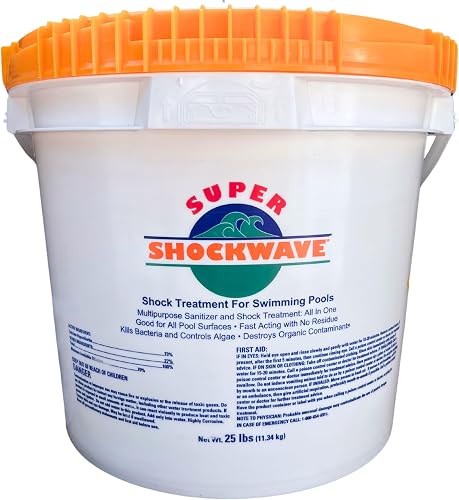
EZ POOLS Super Shockwave Pool Shock: Best 73% strength bucket
- 73% Cal-Hypo granular sanitizer
- 25 pounds
- Fast-dissolving formula
- Defends against bacteria, algae and microorganisms
A 25 lb bucket at 73% Cal-Hypo for owners who want the highest stated strength here.
Pros
- Highest stated strength
- Fast-dissolving
- 25 lb size balances bulk and storage
Cons
- Bucket requires measuring each dose
EZ Pools Super Shockwave suits owners who want the highest stated strength here. It is a 73% Cal-Hypo granular sanitizer in a 25 lb bucket.
The fast-dissolving formula aims to eliminate organic contaminants, bacteria and algae. That strength suits heavy-use pools and algae recovery.
The 25 lb size is easier to store than a 50 lb bucket. You still need to measure doses, since this is not a pre-measured bag.
In daily use the higher percentage is attractive when water turns dull quickly after parties or heat. A fast dissolving granule can restore clarity for a swim or a soak, and the mid-size bucket holds enough for many weekly treatments without the footprint of a 50 lb container.
The trade-off is dose clarity. Fewer details are given on gallons per pound than with 68% options, so you must follow the label dose exactly and test free chlorine before swimming.
Strength alone will not fix a dose that is too small for your pool volume.
Choose it if you want 73% strength and a mid-size bucket. Choose a 68% bag option if you want simpler weekly dosing.
How do cal hypo shock strengths compare?
68% Cal-Hypo is the standard strength in this group. It provides about 65% available chlorine and handles weekly maintenance and algae blooms.
73% Cal-Hypo is stronger on paper. EZ Pools Super Shockwave uses that strength, so a given weight may deliver more chlorine.
Strength alone does not decide the best pick. Dose per gallon, dissolution speed and pack format matter just as much.
68% options
In The Swim, Doheny's and Pool Shark all use 68% Cal-Hypo. Bags and buckets both work well when the dose is right.
73% option
Super Shockwave is the only 73% pick here. Choose it for strength, but confirm the dose for your pool size.
What is cal hypo pool shock and when should you use it?
Cal hypo pool shock is calcium hypochlorite, a granular chlorine that raises free chlorine quickly. It kills bacteria and algae and clears cloudy water.
Use it weekly, after heavy use, after rain or when algae appears. Our pool shock vs liquid chlorine guide explains when each form fits better.
Cal hypo also raises pH and hardness over time. Test pH and alkalinity regularly and adjust as needed.
Signs you need a shock
Cloudy water, chlorine odor, dull water and visible algae are common signs. A shock after a pool party also helps remove swimmer waste.
How much cal hypo shock do I use per gallon?
Use about 1 lb per 10,000 gallons for most 68% products here. Clorox XtraBlue Plus uses 1 lb per 12,000 gallons.
Spread granules in the deepest part with the filter running. Brush if needed and avoid letting granules sit on a liner.
For heavy algae, some brands suggest 2 to 3 doses. Our best pool shock for inground pool guide covers dose planning for larger pools.
Pre-dissolve for liners
Pre-dissolve or dilute granules in a bucket using pool water. That step helps avoid bleaching vinyl or plaster surfaces.
Cal hypo vs other shock types: which should you use?
Cal hypo is non-stabilized and adds no CYA. Dichlor adds CYA and suits spas or pools that need stabilizer.
Our non chlorine shock vs chlorine shock guide compares oxidizers with chlorine shocks. Non-chlorine shock does not raise chlorine, so it will not kill algae the same way.
If you want chlorine-free care, see our best chlorine free pool shock picks. For dichlor, see best dichlor pool shock.
Liquid chlorine as an alternative
Liquid chlorine is already dissolved and easy to dose. Our can you use liquid chlorine to shock pool guide covers that option.
Granular cal hypo stores longer and costs less per dose. Liquid is faster to apply but heavier to carry.
Which cal hypo shock fits your pool type?
Vinyl liners need pre-dissolved granules and gentle application. HTH and Clorox options here state vinyl compatibility.
Saltwater pools can use cal hypo, but confirm your salt cell and surfaces accept it. Our can you shock a saltwater pool guide explains the checks.
Above ground pools often suit smaller packs. Our best pool shock for above ground pools guide lists size-based picks.
Vinyl liner care
Our best pool shock for vinyl liners guide covers liner-safe dosing. Always keep undissolved granules off the liner.
Saltwater care
Our best pool shock for salt water pools guide covers salt system checks. Test chlorine before swimming.
How do you use cal hypo shock safely?
Run the filter, spread granules in the deepest part and brush as needed. Test free chlorine before swimming.
Store cal hypo dry, away from heat, kids and pets. Keep it separate from acids and other chemicals.
Our shock treatment pool safety guide covers handling and storage. If you want a non-chlorine routine, see non chlorine pool shock how to use, and check can you use pool shock in a hot tub before using pool shock in a spa.
CYA and chlorine lock
Cal hypo adds no CYA, so it avoids chlorine lock from overstabilization. If CYA is already high, a different plan may be needed.
Our best pool shock without cyanuric acid guide covers that case. Liquid shock options are in best pool shock liquid gallon.
More guides on this topic
- How to Use Non-Chlorine Pool Shock
- Can You Shock a Saltwater Pool?
- Best Pool Shock for Above-Ground Pools
- Can You Use Liquid Chlorine to Shock a Pool?
- Best Chlorine-Free Pool Shock
- Best Pool Shock for Vinyl Liners
- Best Pool Shock Without Cyanuric Acid
- Best Dichlor Pool Shock
- Can You Use Pool Shock in a Hot Tub?
- Best Pool Shock for Saltwater Pools
- Best Liquid Pool Shock in Gallon Containers
- How to Handle Pool Shock Safely
Final verdict: which cal hypo shock should you buy?
Buy HTH 52037R for weekly no-CYA care. Buy a 68% bulk bucket for large pools.
Buy 1 lb bags if you want no measuring.
The best calcium hypochlorite pool shock is the one you will use weekly at the right dose. Match pack size to your gallons and pool surface.
Our top 3 picks at a glance
-
1
-
2
-
3
Frequently asked questions
What is cal hypo pool shock?
Cal hypo pool shock is calcium hypochlorite, a granular chlorine shock that raises free chlorine fast. It is non-stabilized, so it adds no cyanuric acid.
Use it weekly or after heavy use, rain or algae, then test before swimming.
How much cal hypo shock should I use?
Most products here use about 1 lb per 10,000 gallons. Clorox XtraBlue Plus uses 1 lb per 12,000 gallons.
Always follow the dose for the bag you buy, spread it in the deepest part and brush if needed.
Is cal hypo safe for vinyl liners?
Yes, when you pre-dissolve or dilute it and keep granules off the liner. HTH and Clorox options here state vinyl compatibility.
Pre-dissolving helps avoid bleaching or staining the liner surface.
Can I shock a saltwater pool with cal hypo?
Yes, several options here state saltwater compatibility, including HTH 52037R and Pool Shark. Check that your salt system and surfaces accept chlorine shock.
Test free chlorine before swimming.
Does cal hypo add CYA?
No. Calcium hypochlorite is non-stabilized and adds no cyanuric acid.
That is why HTH highlights no CYA to avoid overstabilization.
Dichlor and trichlor products do add CYA.